Showing posts with label News about the Church and the Christians. Show all posts

Christian Land Ownership in Lebanon in Continuous Decrease


After the proclamation of independence of Lebanon, 8130 square km of land belonged to the Lebanese Christians. Today, however, Lebanese Christians have about 4 thousand km of land. These figures provided by Talal al-Doueihy, head of the Movement "Lebanese Land-Our Land Movement" are eloquent, with regards to some remarks reported by the The Daily Star newspaper. The drastic decrease in landed properties belonging to Christians in the Country of the Cedars has various causes, and is also connected with the strong emmigration tendencies that characterize the Christian portion of the Lebanese population. 

The christian area of Debbieh which has been recently the center of polemics
after several large land sales to non christians

Many Christians wishing to emigrate, sell their land to Muslims buyers before leaving. In addition, during the years of the government of Rafiq Hariri - Prime Minister from 1992 to 1998 and then from 2000 to 2004, who was killed in a bloody suicide bombing on February 14, 2005 - the law regarding the sale of land which guaranteed the right of first refusal to owners of adjacent lands was canceled. The Hariri government wanted in this way to encourage investments in Lebanon from the Arab Gulf countries. The result is that almost all of the lands sold during those years increased from Christian owners to Muslim owners.

Several legislative proposals have been presented in parliament to try to block the erosion of the land ownership of Christians in Lebanon. The one presented by the MPs Sami Gemayel and Ibrahim Kanaan aims to regulate the ownership of land property in Lebanese territory by foreign buyers. While that prepared by the Parliamentary Joseph Maalouf aims to curb the change of ownership of plots of land above 3 thousand square meters, and to limit the room for maneuver of intermediaries in the sale of land.

Secret Conversions to Christianity in Lebanon

According to a local bishop, numerous conversions of Muslims to Christianity occur every year in Lebanon but the true number is unknown because of the risk of social stigma and persecution. “Most of them try to go outside from Lebanon, to Europe or America or Canada or Australia to live there, because it’s not possible to be converted and to stay here,” a Catholic bishop in Lebanon said in a phone interview.

Qadisha Valley or "The Valley of the Saints" in Northern Lebanon

“It’s very, very hard to know how many are baptized, because everything will be a secret.” Given the delicacy of conversion in Lebanon – a Middle Eastern country with a slight Muslim majority – the bishop spoke on condition of anonymity. While the region is lauded for its comparative plurality as Muslims generally coexist well with the Christian population, some hostility can be present toward those who convert from Islam. 

“I have heard many stories about the conversion of Muslims,” he said, in both the Maronite and Melkite communities – the two largest Catholic groups in the country. The bishop cited one Melkite priest who baptized 75 Muslims last year. “Most of them left Muslim areas to stay in the Christian area,” he said, and many are trying to emigrate.

One young woman from Baalbek was converted, he recounted, and her family “accused the priest of having used sorcery to make her convert to Christianity.” “The priest was then abducted and kidnapped by the family. A deal was done after that between the diocese and the tribe of the family, that the family would bring the daughter back home, without torturing her.” Her family has since converted as well, he explained, “but in a secret way.”

If converts from Islam are not able to leave Lebanon, he said, they often move to areas of Lebanon with larger concentrations of Christians: “other people left the Beqaa valley to stay in Beirut, or in Jounieh, in the Christian country.”

Those converting to Christianity in Lebanon are by and large Lebanese themselves, the bishop explained, saying, “I know only one Syrian.” This Syrian convert is from Aleppo, and was in Beirut studying sharia to become a sheikh.

The man “was baptized in Lebanon and now he’s married, but he cannot register his marriage in Syria. He’s in big trouble now because he cannot go to Syria, and he cannot register his marriage in Lebanon either. We are trying now to see if he can go outside of Lebanon, to Europe or somewhere else, to live there with his family.”

Lebanon, according to the U.S. state department, has no procedures for civil marriage; all marriages performed there are performed by religious officials. “Everything is a secret,” the bishop said. “It’s not easy to speak publicly about … conversion to Christianity.”

Lebanon, where it is not easy to speak publicly about Christian conversion, “is better than other Arabic countries. But we still have a problem,” he said. 

The Lebanese constitution provides for freedom of religion, and members of parliament and cabinet officials are all apportioned among Muslims and Christians. National identity cards generally include the bearer’s religion, though this is not required by law.

“It’s easy for a convert to register with the state as a Christian,” the bishop said. “In other countries it’s not possible. I know for example in Egypt there are many conversions, but they still are registered as a Muslim, not Christian.”

Even though the Lebanese government provides for religious freedom, societal discrimination against converts is widespread. The bishop reported that families of converts often “never accept” their relative’s Christian faith, and the convert “is persecuted by his family and his tribe, by his village.”

While the country has long been able to live in the tension between its religious groups – an estimated 54 percent Muslim, 41 percent Christian – the large influx of Syrian refugees in the wake of the neighboring country’s civil war has strained the status quo.

The Lebanese government estimates that more than 1 million Syrian refugees are living in the country. In 2011, at the start of Syria’s civil war, Lebanon’s population was estimated at a little over 4 million.

Now that nearly 20 percent of Lebanese residents are Syrian refugees, inter-religious relations are stressed. On Feb. 3, a suicide bomber wounded several in a district of Beirut largely home to Christians and Druze.

The bishop said that his diocese is assisting both Christian and Muslim refugees.

“When we receive Muslims, we help them without trying to convert them, because when we give material help, we don’t like to play this game.”

Pope Francis To Name 16 New Cardinals


In the wake of Pope Francis’ eagerly anticipated announcement of the names of the new Cardinals, the Director of the Press Office of the Holy See, Father Federico Lombardi, SJ, offered the following observations:

The Pope has adhered to the rule of 120 Cardinals under 80 years of age who will be eligible to vote in a papal election. Currently there were 13 seats “vacant”; 3 others will be “vacant” by the end of May. So the Pope has chosen 16 electors.

Of the 16 eligible to vote, 4 are members of the Curia (i.e., ¼ of the total) and 12 are residential archbishops or bishops, all from different countries .

The distribution of electors who are residential prelates is well distributed among the different continents: Two from Europe, three from North and Central America, three from South America, two from Africa, and two from Asia.

The choice of Cardinals of Burkina Faso and Haiti shows concern for people struck by poverty.

Two residential prelates were chosen from places not traditionally considered Cardinalatial Sees (namely, Perugia in Italy, and Cotabato on the island of Mindanao in the Philippines).

Among the Cardinals who are not electors, one should notice Archbishop Capovilla, the secretary of Pope John XXIII (who will soon be canonized during the 50th anniversary of the Second Vatican Council).

Archbishop Capovilla, aged 98, is the oldest of the Cardinals-elect; the youngest, Bishop Langlois (55 years old).

Pope Francis is the 4th Most Powerful Person in the World for 2013


What do the president of Russia, Pope Francis and the hoodie-wearing CEO of Facebook all have in common? They’re all featured on Forbes’ 2013 ranking of the World’s Most Powerful People, an annual snapshot of the heads of state, financiers, philanthropists and entrepreneurs who truly run the world.

With 7.2 billion people living on our planet, the list represents the collective wisdom of top Forbes editors, who consider hundreds of nominees before ranking the planet’s 72 power brokers — one for every 100 million on Earth. Their power is measured along four dimensions.

First criteria is whether the candidate has power over lots of people. Pope Francis' rank is 4 as he is the spiritual leader of 1.2 billion Catholics, or about 1/6th of the world’s population. His predecessor Pope Benedict XVI was the fifth most powerful person in 2012 according to the same ranking.

Next, the financial resources controlled by each person is assessed. Are they relatively large compared to their peers? For heads of state GDP is used, while for CEOs, their company’s assets and revenues. When candidates have a high personal net worth, it is also taken into consideration. In certain instances, other valuable resources at the candidate’s disposal are taken into consideration like oil reserves.

Lastly, the active use of power is checked. President Vladimir Putin scored the highest points in 2013 because he so frequently shows his strength at home and on the global stage . President Barack Obama, president of the most dominant country in the world, comes in at No. 2, followed by Xi Jinping, general secretary of the Communist Party of China, and Pope Francis. The fifth most powerful person in the world also happens to be the most powerful woman: Angela Merkel, the chancellor of Germany, down from No. 2 last year.

To calculate the final rankings, Forbes editors ranks all candidates in each of these four dimensions of power, and those individual rankings are averaged into a composite score. 

Syrian Refugees in Lebanon Face Death From Cold and Disease


A fierce winter snowstorm has heightened the misery and appalling living conditions facing most of the more than one million Syrian refugees in Lebanon. The President of Caritas Lebanon, Father Simon Faddoul says it’s certain that many Syrian refugees will die from cold and disease this coming winter and all of them are suffering right now. He spoke about their desperate plight.

After the UN, Caritas Lebanon is the main non-governmental provider of aid to the estimated 1.1 million Syrian refugees who have fled to Lebanon to escape the civil war in their homeland. Father Faddoul describes it as “a very gloomy situation” for many of these refugees, saying they live “in horrible conditions.” 

Although the Syrian refugees face a variety of living conditions in Lebanon, ranging from rented apartments, to tents, to uninhabited buildings or shacks. Father Faddoul says large numbers of them are living in makeshift shacks or even more unsanitary conditions: “ I know and visited a family of 10 who are living in a cowshed,” he says, amidst the dirt and with no infrastructure whatsoever. But regardless of the quality of their shelter, “they are all suffering… and it’s a very sad scene.”

Father Faddoul says the arrival of the first winter weather has exacerbated those sufferings, especially for the children and the elderly, because so many of the Syrian refugees lack proper winter clothing and there is “a lack of oil and gas” for heating. He also points out that there is a huge increase in deforestation levels in Lebanon because the refugees are cutting down so many trees to burn the wood and keep warm during the bitter cold. 

Asked whether the influx of refugees from Syria is still continuing, Father Faddoul replies that every day between two and three thousand Syrians are crossing over the border, putting a further strain on the already over-stretched resources of Lebanon. And he concludes by warning that with the coming of the winter cold, the refugees’ already “extremely difficult” living conditions are likely to worsen and will definitely lead to loss of life. “Certainly many will die from cold and disease.”

Maronite Patriarch Along With Six Other Cardinals To Catholic Education


Pope Francis on Saturday November 30, confirmed Cardinal Zenon Grocholewski as prefect of the Congregation for Catholic Education and Archbishop Angelo Vincenzo Zani as secretary, and appointed seven cardinals as members of the dicastery.

The seven cardinals include: Béchara Boutros Raï, Maronite Patriarch of Antioch; Odilo Pedro Scherer, archbishop of São Paulo; John Njue, archbishop of Nairobi; Timothy Michael Dolan, archbishop of New York; John Tong Hon, bishop of Hong Kong; Luis Antonio G. Tagle, archbishop of Manila; and Kurt Koch, president of the Pontifical Council for the Promotion of Christian Unity. 

He also appointed the following archbishops as members of the dicastery: Beniamino Stella, prefect for the Congregation for the Clergy; Ricardo Ezzati Andrello of Santiago de Chile; Marek Jędraszewski of Łódź; and Jorge Carlos Patrón Wong, secretary for seminaries for the Congregation for the Clergy.

The Pope confirmed the following cardinals as members of the dicastery: Antonio María Rouco Varela, Christoph Schönborn, Audrys Juozas Bačkis, Óscar Andrés Rodríguez Maradiaga, José da Cruz Policarpo, Peter Kodwo Appiah Turkson, Josip Bozanić, Péter Erdő, Marc Ouellet, Jean-Pierre Ricard, Oswald Gracias, Laurent Monsengwo Pasinya, Reinhard Marx, Thomas Christopher Collins, Willem Jacobus Eijk, Leonardo Sandri, Gianfranco Ravasi, Fernando Filoni, João Braz de Aviz, and Edwin Frederick O'Brien. 

He also confirmed the following archbishops as members of the dicastery: Alfredo Horacio Zecca, Gerhard Ludwig Müller, and Charles Morerod.


Pope Francis Meets with Patriarchs and Heads of Middle East Catholic Churches


Pope Francis appealed for universal respect of the basic right to religious liberty on Thursday, especially in lands where Christian communities constitute struggling minorities. The call came in the second of two related addresses to the Patriarchs and Major Archbishops of Eastern Churches, who are in Rome this week for the Plenary Assembly of the Congregation for Eastern Churches, and to the full body of participants in the Assembly. In his remarks to the Patriarchs and Major Archbishops, the Holy Father thanked his brothers for their visit, saying their coming together gives him the opportunity to renew his esteem for the spiritual patrimony of Eastern Christianity.

Citing the words of his predecessor, Pope emeritus Benedict XVI in the post-Synodal exhortation, Ecclesia in medio oriente (nn. 39-40), Pope Francis said, “[You are] watchful guardians of communion and servants of Ecclesial unity,” adding, “that union, which you are called to realize in your Churches, finds natural and full expression in the ‘indefectible union with the Bishop of Rome’.” Pope Francis went on to say, “In order that our witness be credible, we are called ever to seek justice, mercy, faith, charity, patience and meekness.”

The Holy Father also delivered a separate address to all the participants in the Congregation’s Plenary Assembly, which is looking at the Eastern Churches a half century on from the II Vatican Ecumenical Council. Pope Francis spoke of his joy at the new growth and flowering of the Churches that spent long decades of oppression under Communist regimes, and also of the perseverance of the Churches in the Middle East, which often live as “little flocks” in areas signed by hostility and conflict. Pope Francis’ thoughts turned in a particular way, “To that blessed land in which Christ lived, died and rose again. “Every Catholic,” he said, “owes a debt of gratitude to the Churches living [there].” The Pope specifically mentioned the plight of Christians in Egypt, Syria and Iraq, saying that there and elsewhere throughout the region there is often too much cause for weeping. 

“The Bishop of Rome will not rest,” he said, “so long as there are men and women, of any religion, affected in their dignity, deprived of life’s basic necessities, robbed of a future, forced to the status of refugees and displaced persons.” He went on to say, “Today, along with the pastors of the Churches of the East, we make an appeal: that the right of all [people] to a decent life and to freely profess their faith be respected.”


One Third of Syrian Christians Are Now Refugees


Some 450,000 Syrian Christians have fled their homes or the country, according to the country’s Melkite Greek Catholic patriarch, almost a third of the pre-war population of 1.75 million.

Speaking in central London ahead of the launch of a new report into the persecuted Church, Patriarch Gregory III Laham gave a devastating picture of life for Syrians but said that neither he nor other Christians had “hate in their heart”, despite the suffering of the community.

The Syrian Patriarch said that three Christians in Maaloula, north of Damascus had been murdered after refusing to convert to Islam. The Aramaic-speaking village is still empty and controlled by Islamist rebels after they attacked in early September, but the Patriarch said that he was hopeful that they would return to the village before Christmas.

Despite fears about an Islamist takeover if the Assad regime fell, the patriarch said that the Christian community remained neutral and said that “reconciliation” was the only way forward: “I am willing to give my life”.

He said, however, that “both sides are willing to go to the bitter end”, and joked that they should wish for a “better end”. The patriarch also said that Pope Francis’s prayers for peace had helped to stop the western powers from bombing Damascus.

The Patriarch was in London as a guest of the charity Aid to the Church in Need, which will today launch its latest report, Persecuted and Forgotten? at the House of Lords.

The report claims that persecution of Christians is getting worse around the world, especially in majority Islamic and some authoritarian Marxist states.

One of the report’s authors, said: “The principal finding of the report is that in two thirds of the countries where persecution of Christians is most severe, the problems have become arguably even worse. In fact the Church’s very survival in some parts – notably the Middle East – is now at stake.”

Pope Francis Meets Orthodox Patriarch of Antioch Youhanna X Yazigi


The pain and suffering of Christians in Syria was at the heart of a meeting that Pope Francis had on Friday with Patriarch Youhanna X Yazigi, head of the Greek Orthodox Church of Antioch and All the East. On Sunday the Patriarch will attend Mass in St Peter’s Square, celebrated by the Pope to mark the Day of Catechists. He’s also due to meet with Italy’s foreign minister and attend the St Egidio international, interfaith conference which opens at the weekend.

In his encounter with the Holy Father, the Patriarch spoke about the difficulties facing the Christian community in Syria and the surrounding region. He also talked about the plight of his own brother who was kidnapped last April, together with the Syriac Orthodox Bishop of Aleppo. The two leaders also shared their hopes for progress on the journey towards full Christian unity.

Then, answering journalists questions, Patriarch Yazigi said:
"First of all I’d like to express my deep, heartfelt love to my dear brother in Christ….I bear in my heart all the pain of our people in Syria, in Lebanon, in the Middle East, and we consider the attitude of His Holiness towards our people, our Church in the Middle East, in Syria and Lebanon especially to push, to find solutions, to establish a peace through dialogue, not in war ..

[Pope’s day of prayer and fasting for peace] It was very important I think, and in fact all our people participated that day, all together, in praying for Syria, for the Middle East, for peace in all the world, and it was a very important message to all the world, and I think to all the governments – not the simple people, but to the states and to the governments, to find a solution through peace.

[Kidnapped brother] Unfortunately we hope and we pray, and we try on all levels – with the governments, with different people – to find a solution to this story, and we hope, but till now we don’t have unfortunately any official or sure information about our two brothers....we hope they’re still alive...

[Who’s responsible?] They haven’t given us any sure answer till now – a lot of stories, a lot of promises, but not any results unfortunately.

[Did you talk about this with the Pope?] Yes, absolutely. We discussed a lot of topics and subjects. First of all I expressed all my brotherly love to His Holiness personally, and all my love of our Churches, the Antiochian Orthodox Church – as you know always in history we’ve had a good relationship and cooperation with the Catholic Church, with Vatican City. ....And we talked about our progression towards unity, Christian unity as you know, dialogue between the Orthodox Church and the Catholic Church. We try, we want to do what we can do, all together – this is the desire of His Holiness, and our desire. And about this political situation, about the presence of Christians in the Middle East – it’s a very important issue now, because a lot of our people are leaving Syria or Lebanon for other countries, and we cannot accept the Middle East without the face of Christ.

[Will there be a solution to the conflict now there’s been an agreement on chemical weapons?] We hope, and we ask all the governments to help us and to push all the countries to help Syria to find a solution through dialogue, and especially Russia and the States, and Europe maybe – they have a very big and important role, and we hope to help in this way

[Hard-line Islamic presence after conflict?] About Islam, you know, we have very good relationships with the Muslim people, in general in all his area. We live together, we have the same history, the same future – we’re like one family, this is the truth. But now we see in our countries a new spirit of extremism from some groups, Islamic groups, and we all refuse that – and the Muslim people, they refuse this extremist Islamic spirit.

[Can religious leaders help?] Absolutely. And we all – the Imams in Syria and Lebanon for example, and the bishops, the priests – we are all together. And we try with our people – with the Christians, with the Muslims – to do what we can do to have a calm life, and peace.

[St Egidio, The Courage of Hope] We try to be with our people, and to give them some hope, to stay in their houses, in this land, in this Christian land. And I would like to thank St Egidio for their invitation, and it will be an occasion for me to say some words, maybe a message of our pain, in the Middle East, in Syria and Lebanon, especially to make this voice heard by all the world.

[Do you fear for yourself?] No. There is a danger, but for example I live now in the Patriarchate in Damascus, sometimes in Lebanon in our residence in Balamand, near Beirut, and our church is open, we have our liturgies, our services as usual. Except some areas absolutely where we have difficulties, in Aleppo, in Homs, in others.


Pope Francis Celebrates Mass with Maronite Patriarch in the Vatican


Shame before God; prayers to implore divine mercy and unreserved trust in the Lord. Pope Francis' reflection at the Chapel of the Domus Sanctae Martae on the morning of Wednesday 25 September, was based on these. The Holy Father concelebrated with Cardinal Leonardo Sandri, Prefect of the Congregation for the Eastern Churches, and with Cardinal Béchara Boutros Raï, Patriarch of Antioch for Maronites, together with a group of Maronite Bishops from Lebanon, Syria and the Holy Land as well as from various other countries on every continent.

In commenting on the Readings of the Liturgy (Ezra 9:5-9; Lk 9:1-6), the Pope said that the passage from the Book of Ezra in particular had reminded him of the Maronite bishops and, as usual he summed up his thoughts on three concepts. First of all Ezra's shame and embarrassment before God which was so acute that he could not raise his eyes to him. Shame and consternation are common to all of us, because of the sins we have committed that have brought us into bondage for serving idols that are not God.

Prayer is the second concept. Following the example of Ezra who falling upon his knees spread out his arms to God, beseeching him for mercy, we must do likewise in reparation for our innumerable sins. It is a prayer, the Pope said, which we should also raise to God for peace in Lebanon, in Syria and throughout the Middle East. Prayer, always and everywhere, he explained, is the road we must take in order to face difficult moments as well as the most dramatic trials and the darkness which at times engulf us in unforeseeable situations. To find our way out of all this, the Pontiff emphasized, it is necessary to pray ceaselessly.

Lastly, boundless trust in God who never abandons us. This was the third concept presented by the Holy Father. We may be certain, he said, that the Lord is with us, and therefore we must be persevering on our journey, thanks to hope which instils fortitude. The pastors' word will become reassuring to the faithful: the Lord will never abandon us.

After communion, Cardinal Béchara Raï expressed his gratitude to the Holy Father and a deeply cordial greeting on behalf of the participating bishops, of all Maronites and of the whole of Lebanon, confirming their faithfulness to Peter and to his Successor, “who sustains us on our all too often thorny path”. The Cardinal thanked the Pope in particular for the strong impetus he has given to the quest for peace: “His prayers and his exhortations for peace in Syria and in the Middle East have sown hope and comfort”.
إلى كل من فقد فلذة كبده في ريعان الشباب
بقلم ألفريدو لاما


الرياح المكسورة

كفراشة الحقل رفراف الجناح ...
فوق كل الزهر بزهاء طائف
كزنبق الطهر متلألئ الوشاح ...
من عين قطرات الندى راشف
كهدوء الليل متمكن الحواس ...
بلمعان من بريق النجم شاغف
يختال شموخا في نضج وزهو...
يسرح ميادا وللأنظار خاطف
عنفوان في ربيع العمر هائم ...
يتيه نبلا خلوقا جياش العواطف
مرهف الحس حاضر الذهن ...
لا يبدو من مرارة العيش خائف
على عتبة الدراسة خطواته ...
من خلفها شاطىء الطفولة عازف
ألحان الثقافة في شجوغناؤه ...
وللعلم تواق ماخرعباب المصاحف
لم يعطه القدر مقدارا من قدره...
فجاء نوءه دون وازع للنفس عاصف
انطفئت شموع الحياة في بغتة...
فانكسرت رياح الروح بصاعق آزف
ترك على اطلاله نواقيس تدق...
ذكرى يعتصر رنينها شوك آلام نازف
واحبيبي كيف تتركني ولداه ...
الهي،، بقلبي بروحي قد غار سيف قاصف.

الفريدو لاما


Pope Francis Signs the Canonization Decrees For John XXIII And John Paul II


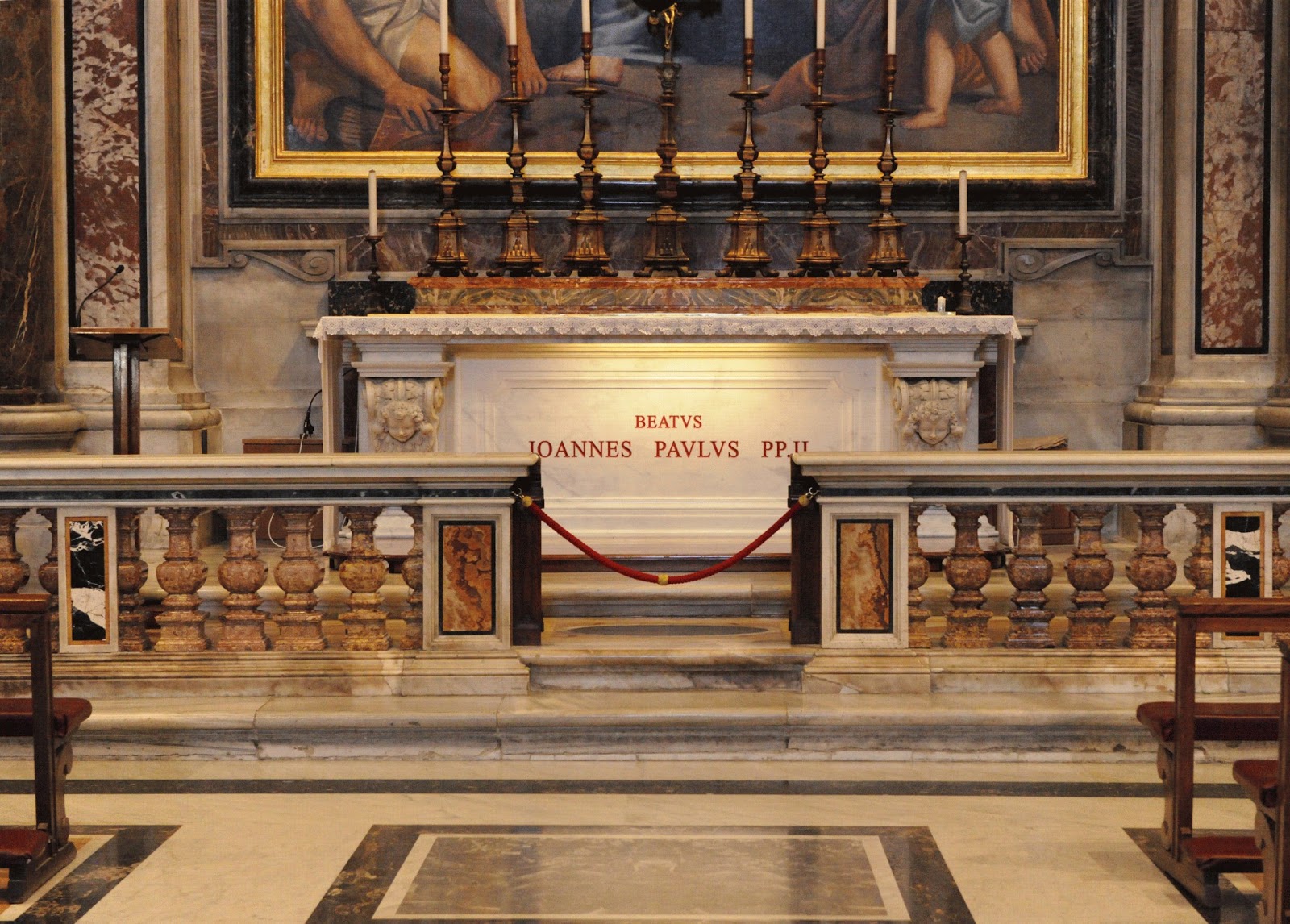
Pope Francis has approved the cause for canonization of two of his venerable and much loved predecessors Blessed John XXIII and Blessed Pope John Paul II. Meeting with Cardinal Angelo Amato, Prefect of the Congregation for the Cause of Saints, Friday morning, Pope Francis approved the promulgation of the decree and also convoked a special Consistory of the College of Cardinals to discuss the canonization of the Polish pope in depth. 


Blessed Pope John Paul II's Tomb at the Vatican

Furthermore, he approved the favorable votes of the Ordinary Session of the Congregations Cardinals and Bishops regarding the raising to the altars of sainthood of Blessed John XXII. This slightly unusual gesture was explained by Fr. Lombardi who told journalists that despite the absence of a second miracle it was the Pope’s will that the Sainthood of the great Pope of the Second Vatican Council be recognized. 

Fr. Lombardi stated that a canonization without a second miracle is still valid, given that there is already the existing miracle that lead to the Roncalli Pope’s beatification. He also pointed to ongoing discussions among theologians and experts about whether it is necessary to have two distinct miracles for beatification and canonization. Certainly, he added the Pope has the power to dispense, in a Cause, with the second miracle.

However, there was no mention of dates. Neither for the Consistory nor for the Canonizations. Fr. Lombardi did not rule out that both celebrations could coincide, and he did express his belief that they would take place by the end of the year. Either way any date would be established during the Consistory.


Cardinal Al Rahi Condemns the Attacks on the Lebanese Army


Maronite Patriarch Beshara al-Rahi described on Monday as “executioners” all parties that use illegitimate arms against the Lebanese people, saying the country was paying the price of their actions. “When we use illegitimate arms against the people of our nation we all become executioners,” al-Rahi said during a ceremony in Adma, north of Beirut.

“There is only one victim that is Lebanon,” he said. “They are all executioners!” he added about the March 8 and 14 alliances whom he blamed for the deteriorating security situation in Lebanon. He said the attack on the army in the southern city of Sidon is an assault on the state, the dignity of the people and the nation's self-esteem. He also described the attack on state institutions as “a crime against the people and high treason.”

At least 12 soldiers have been killed in less than 24 hours of clashes with supporters of Salafist cleric Sheikh Ahmed al-Asir in Sidon. The fighting intensified on Monday, a day after the violence began, when al-Asir's supporters opened fire on an army checkpoint in Abra where the cleric's Bilal Bin Rabah mosque lies.

Al-Rahi condemned “all those covering up for the crimes, including politicians,” saying they were as guilty as those committing the crimes. He urged the judiciary to arrest Sidon's gunmen and give them the ultimate punishment “although some politicians, who are professionals in covering up for crimes, might pressure it.”

The patriarch said Sidon's fighting and similar cases in different regions in addition to the involvement in Syria's war came despite the Baabda declaration in which different parties had pledged to distance Lebanon from the region's crises. “They are the results of the persistence to paralyze state institution and dismantle them,” he said.

Historical Meeting Between Pope Francis and the Archbishop of Canterbury

On Friday June 14, Pope Francis met with the new Archbishop of Canterbury, Justin Welby. It was the first meeting between them. At the end of his visit to the Vatican, Archbishop Welby, said he and Pope Francis shared ideas on economic justice, on the plight of Christians in the Middle East, but also on their deeply personal experiences of God’s calling in their daily lives.Following their morning audience and joint prayer service, the leader of the Anglican Communion described the Pope as a man of “extraordinary humanity, on fire with the Spirit of Christ”. While admitting there are obstacles on the road to reconciliation between Anglicans and Catholics, he said he sensed a new vigour and common commitment “to prove the radicality” of the Christian Gospel.Speaking to Philippa Hitchen in the garden of the Venerable English College at the end of the brief visit, the archbishop said he and the Pope also joked about the way they had inaugurated their ministries within two days of each other earlier this year!

Below, is the translation of Pope Francis' discourse at the meeting, followed by the complete text of Archbishop Welby's address: 

Your Grace, Dear Friends,
On the happy occasion of our first meeting, I make my own the words of Pope Paul VI, when he addressed Archbishop Michael Ramsey during his historic visit in 1966: “Your steps have not brought you to a foreign dwelling ... we are pleased to open the doors to you, and with the doors, our heart, pleased and honoured as we are ... to welcome you ‘not as a guest or a stranger, but as a fellow citizen of the Saints and the Family of God’” (cf. Eph 2:19-20).

I know that during Your Grace’s installation in Canterbury Cathedral you remembered in prayer the new Bishop of Rome. I am deeply grateful to you – and since we began our respective ministries within days of each other, I think we will always have a particular reason to support one another in prayer.

The history of relations between the Church of England and the Catholic Church is long and complex, and not without pain. Recent decades, however, have been marked by a journey of rapprochement and fraternity, and for this we give heartfelt thanks to God. This journey has been brought about both via theological dialogue, through the work of the Anglican-Roman Catholic International Commission, and via the growth of cordial relations at every level through shared daily lives in a spirit of profound mutual respect and sincere cooperation. In this regard, I am very pleased to welcome alongside you Archbishop Vincent Nichols of Westminster. These firm bonds of friendship have enabled us to remain on course even when difficulties have arisen in our theological dialogue that were greater than we could have foreseen at the start of our journey.

I am grateful, too, for the sincere efforts the Church of England has made to understand the reasons that led my Predecessor, Pope Benedict XVI, to provide a canonical structure able to respond to the wishes of those groups of Anglicans who have asked to be received collectively into the Catholic Church: I am sure this will enable the spiritual, liturgical and pastoral traditions that form the Anglican patrimony to be better known and appreciated in the Catholic world.

Today’s meeting is an opportunity to remind ourselves that the search for unity among Christians is prompted not by practical considerations, but by the will of the Lord Jesus Christ himself, who made us his brothers and sisters, children of the One Father. Hence the prayer that we make today is of fundamental importance. This prayer gives a fresh impulse to our daily efforts to grow towards unity, which are concretely expressed in our cooperation in various areas of daily life. Particularly important among these is our witness to the reference to God and the promotion of Christian values in a world that seems at times to call into question some of the foundations of society, such as respect for the sacredness of human life or the importance of the institution of the family built on marriage, a value that you yourself have had occasion to recall recently.

Then there is the effort to achieve greater social justice, to build an economic system that is at the service of man and promotes the common good. Among our tasks as witnesses to the love of Christ is that of giving a voice to the cry of the poor, so that they are not abandoned to the laws of an economy that seems at times to treat people as mere consumers.

I know that Your Grace is especially sensitive to all these questions, in which we share many ideas, and I am also aware of your commitment to foster reconciliation and resolution of conflicts between nations. In this regard, together with Archbishop Nichols, you have urged the authorities to find a peaceful solution to the Syrian conflict such as would guarantee the security of the entire population, including the minorities, not least among whom are the ancient local Christian communities. As you yourself have observed, we Christians bring peace and grace as a treasure to be offered to the world, but these gifts can bear fruit only when Christians live and work together in harmony. This makes it easier to contribute to building relations of respect and peaceful coexistence with those who belong to other religious traditions, and with non-believers.

The unity we so earnestly long for is a gift that comes from above and it is rooted in our communion of love with the Father, the Son and the Holy Spirit. As Christ himself promised, “where two or three are gathered in my name, there am I in the midst of them” (Mt 18:20). Let us travel the path towards unity, fraternally united in charity and with Jesus Christ as our constant point of reference. In our worship of Jesus Christ we will find the foundation and raison d’être of our journey. May the merciful Father hear and grant the prayers that we make to him together. Let us place all our hope in him who “is able to do far more abundantly than all that we ask or think” (Eph 3:20).

Below, is the complete text of Archbishop Justin Welby’s address to Pope Francis, which was delivered in English: 

Your Holiness, 
Dear Friends:
I am full of love and gratitude to be here. In the last few days we have been remembering the death of Blessed Pope John XXIII in the midst of the Second Vatican Council. At the Requiem said at Lambeth Palace fifty years ago this weekend by Archbishop Michael Ramsey, my much-loved predecessor said of him: ‘Pope John has shown us again the power of being, by being a man who touches human hearts with charity. So there has come to many a new longing for the unity of all Christians, and a new knowledge that however long the road may be, charity already makes all the difference to it.’

Having for many years found inspiration in the great corpus of Catholic social teaching, and worked on its implications with Catholic groups; having spent retreats in new orders of the Church in France, and being accompanied by the Prior of another new order; I do indeed feel that I am (in the words of Pope Paul VI to Archbishop Michael) coming to a place where I can feel myself at home.Your Holiness, we are called by the Holy Spirit of God, through our fraternal love, to continue the work that has been the precious gift to popes and archbishops of Canterbury for these past fifty years, and of which this famous ring is the enduring token. I pray that the nearness of our two inaugurations may serve the reconciliation of the world and the Church.

As you have stressed, we must promote the fruits of our dialogue; and, with our fellow bishops, we must give expression to our unity in faith through prayer and evangelisation. It is only as the world sees Christians growing visibly in unity that it will accept through us the divine message of peace and reconciliation.

However, the journey is testing and we cannot be unaware that differences exist about how we bring the Christian faith to bear on the challenges thrown up by modern society. But our ‘goal is great enough to justify the effort of the journey’ (Benedict XVI, Spe salvi 1), and we can trust in the prayer of Christ, ‘ut omnes unum sint’ (Jn 17.21). A firm foundation of friendship will enable us to be hopeful in speaking to one another about those differences, to bear one another’s burdens, and to be open to sharing the discernment of a way forward that is faithful to the mind of Christ pressed upon us as disciples.

That way forward must reflect the self-giving love of Christ, our bearing of his Cross, and our dying to ourselves so as to live with Christ, which will show itself in hospitality and love for the poor. We must love those who seek to oppose us, and love above all those tossed aside—even whole nations—by the present crises around the world. Also, even as we speak, our brothers and sisters in Christ suffer terribly from violence, oppression and war, from bad government and unjust economic systems. If we are not their advocates in the name of Christ, who will be?

Your Holiness, dear brother, I assure you of the love, respect and prayer of the bishops, clergy and people of the Anglican Communion.

Feast of Saint Anthony in Istanbul Amid Turmoil

"Many young people who go to Taksim Square pass by our church, light a candle to St. Anthony, then they go to demonstrate. They are people of all social classes and religions. As Franciscans, in this delicate moment for the country we pray, through the intercession of St. Anthony, for the good and peace in the country ": This is what Fr. Anton Bulai says, he is pastor of the St. Anthony Church in Istanbul, situated in the centre of the town, not far from Taksim Square. 

Protesters at Taksim Square

The local community of six Franciscan friars are preparing the feast of St. Anthony, on June 13, a celebration with ancient roots, and a feast that welcomes Christians of all denominations and many non Christians, devoted to the Saint."It is a feast that involves the whole local Church: we will be close to our Bishop, Mgr. Louis Pelatre who will celebrate Mass. But it is also an ecumenical feast, open to all: religious leaders and believers of all other communities come, " explains friar Anton. There will be a representative of the Ecumenical Patriarchate of Constantinople and non Christian faithful. 

Anthony is a saint known and loved in Turkey especially for the initiative of the "Bread of the poor" where for over 60 years poor people benefit from, without distinction of religion or ethnicity. Fr. Bulai explains: "Every Tuesday, since the time of the Apostolic Delegate Angelo Roncalli, who went to our church, to our convent, one prays and distributes bread to the hungry or needy." In recent years, "a special blessing and gifts for the children" have marked the feast of the 13th of June. 

The feast today is in the midst of a wave of protest that, notes the pastor, "might somehow discourage the participation of the people," given the fear of disorder or violence. From the Church of St. Anthony "there will always be a word of peace, of good and reconciliation." "Our Church and our Franciscan witness in Turkey continues: we are a convent with the doors always open to welcome, we are always ready to pray, bless, and welcome anyone who approaches and comes to light a candle to the Saint: and there are many people who do it every day, of every social class and religion," notes Fr. Bulai.

Beginning of the Synod of the Chaldean Church


On Wednesday, June 5 the Synod of the Chaldean Church convened by the Patriarch of Babylon of the Chaldeans Louis Raphael I Sako began in Baghdad. The beginning of the assembly was also attended by Archbishop Giorgio Lingua, Apostolic Nuncio to Jordan and Iraq. With the arrival of the bishop of Aleppo Antoine Audo, all the Chaldean Bishops - except Sarhad Jammo, Bishop of St. Peter the Apostle in San Diego of the Chaldeans – are gathered in the center of the Iraqi capital.

The agenda of the synodal assembly is more than challenging. Several points on the agenda: the appointment of bishops in several Chaldean bishoprics left vacant; the formation of priests; the final draft of a “law” of the Chaldean Church; updating and harmonization of the liturgical rites celebrated unevenly in the various dioceses; the study of concrete measures to curb the phenomenon of migration and encourage Christians to remain in their homeland or to make return. 

In a statement issued by the Patriarchate of Babylon of the Chaldeans, the bishops called upon all "the sons and daughters of the Chaldean Church" to invoke the success of the Synodal Assembly. The Almighty Father is invoked in order to be helped "to love our Chaldean Church as it is, in all its varieties and differences, in its greatness as its weakness." In front of the "storms" that "blow against the boat in which we find ourselves". .

Vatican Says: 100 Thousand Christians Killed Every Year Because of Their Faith


The Holy See has expressed "deep concern" for violations of religious freedom and systematic attacks on Christian communities in regions of the world such as Africa, Asia and the Middle East. This was pointed out by Msgr. Silvano Maria Tomasi, who spoke Monday at the United Nations in Geneva. Statement by His Excellency Archbishop Silvano M. Tomasi Permanent Observer of the Holy See to the United Nations and Other International Organizations in Geneva 23rd Session of the Human Rights Council Interactive Dialogue with High Commissioner.

Mr. President,
My Delegation congratulates Madam High Commissioner for her presentation as well as for the activities of her office for the promotion, recognition and implementation of human rights.

Mr. President,
The serious violations of the right to freedom of religion in general and the recent continuing discrimination and systematic attacks inflicted on some Christian communities in particular, deeply concern the Holy See and many democratic Governments whose population embrace various religious and cultural traditions. Credible research has reached the shocking conclusion that an estimate of more than 100,000 Christians are violently killed because of some relation to their faith every year. Other Christians and other believers are subjected to forced displacement, to the destruction of their places of worship, to rape and to the abduction of their leaders -as it recently happened in the case of Bishops Yohanna Ibrahim and Boulos Yaziji, in Aleppo (Syria).

Several of these acts have been perpetrated in parts of the Middle East, Africa and Asia, the fruit of bigotry, intolerance, terrorism and some exclusionary laws. In addition, in some Western countries where historically the Christian presence has been an integral part of society, a trend emerges that tends to marginalize Christianity in public life, ignore historic and social contributions and even restrict the ability of faith communities to carry out social charitable services. 

Mr. President, The Human Rights Council has recognized that "religion, spirituality and belief may and can contribute to the promotion of the inherent dignity and worth of the human person." The Christian religion, as other faith-communities, is "at the service of the true good of humanity." In fact "Christian communities, with their patrimony of values and principles, have contributed much to making individuals and peoples aware of their identity and their dignity".

In this connection, it may be useful that the Delegation of the Holy See should recall some pertinent data on the current services to the human family carried out in the world by the Catholic Church without any distinction of religion or race. In the field of education, it runs 70,544 kindergartens with 6,478,627 pupils; 92,847 primary schools with 31,151,170 pupils; 43,591 secondary schools with 17,793,559 pupils. The Church also educates 2,304,171 high school pupils, and 3,338,455 university students. The Church’s worldwide charity and healthcare centers include: 5,305 hospitals; 18,179 dispensaries; 547 Care Homes for people with Leprosy; 17,223 Homes for the elderly, or the chronically ill or people with a disability; 9,882 orphanages; 11,379 creches; 15,327 marriage counseling; 34,331 social rehabilitation centers and 9,391 other kinds of charitable institutions. To such data about social action activity, there should be added the assistance services carried out in refugee camps and to internally displaced people and the accompaniment of these uprooted persons. This service certainly doesn’t call for discrimination against Christian.

Mr. President,
Allow me also to congratulate the Delegations, like that of Italy, that took the floor to express a defense of religious freedom in general and Christians in particular since these have been targeted victims of human rights violations and to welcome the position of the Prime Minister of Bangladesh on the introduction of anti-blasphemy law in her country. In conclusion, Pope Francis’ words regarding the celebration of the 17th Centennial Anniversary of the Edict of Milan, that opened the way to religious freedom, are an appropriate wish, that "… civil authorities everywhere respect the right to publicly express one’s faith and to accept without prejudice the contribution that Christianity continues to offer to the culture and society of our time". Thank you Mr. President.

Historical Meeting Between Pope Francis and Coptic Pope Tawadros II


Pope Francis met on Friday with the leader of the Coptic Orthodox Church, Pope Tawadros II, telling him the future of Egypt and the role of its Christian communities finds a deep echo in the heart of the entire Catholic world. 

Pope Tawadros of Alexandria, who heads the largest Christian Church in the Middle East, is currently making a five day visit to Rome, his first outside Egypt since his enthronement last November. He’s due to hold talks with Vatican and Italian officials, as well as celebrating together with the various Coptic communities here in Italy.

Friday’s meeting between the Catholic and Oriental Orthodox popes comes 40 years to the day after the first historic encounter between Pope Paul VI and Tawadros’ predecessor, Shenouda III, who signed a joint statement pledging the two Churches to the search for reconciliation and unity.

In his speech to Pope Francis, Tawadros proposed that May 10th each year should be marked as a day of celebration between the two communities. He also invited the successor of St Peter to visit his Church, founded by St Mark the Evangelist around the middle of the 1st century.

Following is the full text of Pope Francis' address to Pope Tawadros and his delegation:

Your Holiness,
Dear Brothers in Christ,

For me it is a great joy and a truly graced moment to be able to receive all of you here, at the tomb of Saint Peter, as we recall that historic meeting forty years ago between our predecessors, Pope Paul VI and the late Pope Shenouda III, in an embrace of peace and fraternity, after centuries of mutual distrust. So it is with deep affection that I welcome Your Holiness and the distinguished members of your delegation, and I thank you for your words. Through you, I extend my cordial greetings in the Lord to the bishops, the clergy, the monks and the whole Coptic Orthodox Church.

Today’s visit strengthens the bonds of friendship and brotherhood that already exist between the See of Peter and the See of Mark, heir to an inestimable heritage of martyrs, theologians, holy monks and faithful disciples of Christ, who have borne witness to the Gospel from generation to generation, often in situations of great adversity.

Forty years ago the Common Declaration of our predecessors represented a milestone on the ecumenical journey, and from it emerged a Commission for Theological Dialogue between our Churches, which has yielded good results and has prepared the ground for a broader dialogue between the Catholic Church and the entire family of Oriental Orthodox Churches, a dialogue that continues to bear fruit to this day. In that solemn Declaration, our Churches acknowledged that, in line with the apostolic traditions, they profess “one faith in the One Triune God” and “the divinity of the Only-begotten Son of God ... perfect God with respect to his divinity, perfect man with respect to his humanity”. They acknowledged that divine life is given to us and nourished through the seven sacraments and they recognized a mutual bond in their common devotion to the Mother of God.

We are glad to be able to confirm today what our illustrious predecessors solemnly declared, we are glad to recognize that we are united by one Baptism, of which our common prayer is a special expression, and we long for the day when, in fulfillment of the Lord’s desire, we will be able to communicate from the one chalice.

Of course we are well aware that the path ahead may still prove to be long, but we do not want to forget the considerable distance already traveled, which has taken tangible form in radiant moments of communion, among which I am pleased to recall the meeting in February 2000 in Cairo between Pope Shenouda III and Blessed John Paul II, who went as a pilgrim, during the Great Jubilee, to the places of origin of our faith. I am convinced that – under the guidance of the Holy Spirit – our persevering prayer, our dialogue and the will to build communion day by day in mutual love will allow us to take important further steps towards full unity.

Your Holiness, I am aware of the many marks of attention and fraternal charity that you have shown, since the early days of your ministry, to the Catholic Coptic Church, to its Pastor, Patriarch Ibrahim Isaac Sidrak and to his predecessor, Cardinal Antonios Naguib. The institution of a “National Council of Christian Churches”, which you strongly desired, represents an important sign of the will of all believers in Christ to develop relations in daily life that are increasingly fraternal and to put themselves at the service of the whole of Egyptian society, of which they form an integral part. Let me assure you that your efforts to build communion among believers in Christ, and your lively interest in the future of your country and the role of the Christian communities within Egyptian society find a deep echo in the heart of the Successor of Peter and of the entire Catholic community.

“If one member suffers, all suffer together; if one member is honoured, all rejoice together” (1 Cor 12:26). This is a law of the Christian life, and in this sense we can say that there is also an ecumenism of suffering: just as the blood of the martyrs was a seed of strength and fertility for the Church, so too the sharing of daily sufferings can become an effective instrument of unity. And this also applies, in a certain sense, to the broader context of society and relations between Christians and non-Christians: from shared suffering can blossom forth forgiveness and reconciliation, with God’s help.

Your Holiness, in assuring you of my prayers that the whole flock entrusted to your pastoral care may be ever faithful to the Lord’s call, I invoke the protection of both Saint Peter and Saint Mark: may they who during their lifetime worked together in practical ways for the spread of the Gospel, intercede for us and accompany the journey of our Churches.


President Michel Sleiman Says: "Pray for Me" To Pope Francis

He met Benedict XVI a few months ago to thank him for his trip to Lebanon in September 2012. But the Maronite Christian Lebanese president, Michel Sleiman, decided to return to Rome to meet Pope Francis in the Vatican.


The meeting between the Argentinean pope and Sleiman – who was not able to attend the mass which celebrated the start of Francis’ Petrine ministry last 19 March, because he was not in the country – lasted 25 minutes and the two were assisted by an interpreter. The Prefect of the Papal Household, Mgr. Georg Gänswein, who returned to the Vatican with Benedict XVI yesterday, was also present.

The Lebanese president gave Francis a 20th century icon of the Virgin Mary; in exchange, the new Pope gave him a silver and mother of pearl medallion. Sleiman was accompanied by an entourage of 11 people, including his wife, Wafaa and the vice prime minister Samir Mokbel and his wife.

According to a Vatican Press Office statement, during the audience the two leaders said they hoped for the success of negotiations for the formation of a new government in Beirut. The new government “will face significant challenges on a national and international level.” Lebanon has been without a government since the end of March, after Prime Minister Najij Miqati handed in his resignation. This is second resignation handed in, in the past few months. The former prime minister’s coalition government split over differences in opinion regarding the organisation of the upcoming legislative elections.

Sleiman and Francis also highlighted the importance of dialogue and collaboration between members of the various ethnic and religious communities that make society so rich and varied, in favour of the common good and the development and stability of the nation.”

But the main focus of the audience was, naturally, the Syrian conflict and the tragic situation faced by thousands of refugees who have fled to Lebanon and neighbouring countries. Francis and Sleiman “called for further humanitarian aid with the support of the international community to help the suffering population.”

But in the Vatican there is fear of the repercussions the Syrian crisis could have on Lebanon’s domestic situation, especially on Christians. Last October, just one month after Benedict XVI’s visit to Lebanon, there was a serious bombing in Beirut’s Christian neighbourhood, leading to the death of the head of Lebanon’s secret services, the Lebanese Internal Security Forces (FSI), Wissam al Hassan.

The Vatican statement said there was mention of “the delicate situation faced by Christians in the entire Middle East and the significant contribution they can make.” This was in light of the Post-Synodal Apostolic Exhortation “Ecclesia in the Middle East”, which Pope Benedict XVI delivered on his visit to Lebanon. The Apostolic Exhortation “is an important reference point for Catholic communities and societies in the Region.” Finally, the two leaders wished for “a quick and fruitful resumption of negotiations between Israelis and Palestinians. This is becoming increasingly necessary for peace and stability in the Region.”

Watch the video: