Showing posts with label The Pope's Trips and Journeys. Show all posts

I Saw This Saint!


What a great and awesome feeling, to watch today on TV the canonization of a man whom I saw in a Pope mobile on the streets of Beirut in July 1997 passing just in front of me! It was on a hot Sunday and people were amassed on both sides of the road, trying to catch a glimpse of the Holy Father, who was heading to Beirut Downtown to celebrate Holy Mass, ending his historical trip to Lebanon. I was on the Dora Highway, standing there among thousands of people in one of the renowned Christian suburbs of Beirut.

Everybody was waiting and excited about this passage of the intriguing white Mercedes. Then suddenly the roaring sound of the helicopter of the Lebanese Army accompanying the motorcade from the air was heard. In a split second the crowd was by all means raised and you could hear nothing but loud applause and heavy cheers, one could only see hand waving and tears of joy, Lebanese and Vatican flags floating from every child, boy, mother and elderly people on the street. 

Then the white car appeared, preceded by an endless number of motorcycles, armored cars and vehicles with antennas. It was probably a never seen before motorcade, with a huge number of accompanying officers and military personnel watching over John Paul II with their Lives.

The white man was standing inside the glazed car with the Maronite Patriarch with him, Cardinal Sfeir. The car passed in front of us. John Paul II with his usual smile and firm looks was maybe less than 10 meters away from where I was standing. The sight lasted maybe less than a second, but the picture of the man on that day is still clear and present in my mind after 17 years.

Today on April 27, he is becoming a Saint! Thank you Jesus for showing us that Sainthood could be within reach and touch, it is a lot easier than one might think, it could be one decision away from every man and woman.

Jean Ogassapian, a minister and Lebanese deputy was a Lebanese Army officer in charge of the Pope's personal security on that trip, he said: John Paul II has a powerful influence on people, I spoke with him on the plane but I cannot remember a single word from what he said, but I knew that my life will change after this encounter, and it was so!

Saint John Paul II pray for us, and for all those who walked a long distance on feet to try to get a sight of your holiness on that memorable trip of 1997.


Pope Francis' Homily on Final WYD (JMJ) Mass in Rio de Janeiro, Brazil


Pope Francis on Sunday, July 28, celebrated the concluding World Youth Day Mass in Rio de Janeiro on the beachfront of Copacabana, as the many events and initiatives that filled the articulated World Youth Day program are come to end.

Millions of pilgrims are preparing to leave the city and - as Pope Francis urged them to do - go home to share their experience of faith. Thousands of journalists, reporters, photographers and other media operators are also packing up after a busy week. It was an intense experience of life and of faith, people on the streets said. It was also an event which set a record for a Sunday mass participation, with 3 million faithful, 60 Cardinals, 1500 Bishops and 11000 priests. 

This is the full text of the Pope's homily:


Brother Bishops and Priests,
Dear Young Friends,

“Go and make disciples of all nations”. With these words, Jesus is speaking to each one of us, saying: “It was wonderful to take part in World Youth Day, to live the faith together with young people from the four corners of the earth, but now you must go, now you must pass on this experience to others.” Jesus is calling you to be a disciple with a mission! Today, in the light of the word of God that we have heard, what is the Lord saying to us? Three simple ideas: Go, do not be afraid, and serve.

1. Go. During these days here in Rio, you have been able to enjoy the wonderful experience of meeting Jesus, meeting him together with others, and you have sensed the joy of faith. But the experience of this encounter must not remain locked up in your life or in the small group of your parish, your movement, or your community. That would be like withholding oxygen from a flame that was burning strongly. Faith is a flame that grows stronger the more it is shared and passed on, so that everyone may know, love and confess Jesus Christ, the Lord of life and history (cf. Rom 10:9).

Careful, though! Jesus did not say: “if you would like to, if you have the time”, but: “Go and make disciples of all nations.” Sharing the experience of faith, bearing witness to the faith, proclaiming the Gospel: this is a command that the Lord entrusts to the whole Church, and that includes you; but it is a command that is born not from a desire for domination or power but from the force of love, from the fact that Jesus first came into our midst and gave us, not a part of himself, but the whole of himself, he gave his life in order to save us and to show us the love and mercy of God. Jesus does not treat us as slaves, but as free men, as friends, as brothers and sisters; and he not only sends us, he accompanies us, he is always beside us in our mission of love.

Where does Jesus send us? There are no borders, no limits: he sends us to everyone. The Gospel is for everyone, not just for some. It is not only for those who seem closer to us, more receptive, more welcoming. It is for everyone. Do not be afraid to go and to bring Christ into every area of life, to the fringes of society, even to those who seem farthest away, most indifferent. The Lord seeks all, he wants everyone to feel the warmth of his mercy and his love.

In particular, I would like Christ’s command: “Go” to resonate in you young people from the Church in Latin America, engaged in the continental mission promoted by the Bishops. Brazil, Latin America, the whole world needs Christ! Saint Paul says: “Woe to me if I do not preach the Gospel!” (1 Cor 9:16). This continent has received the proclamation of the Gospel which has marked its history and borne much fruit. Now this proclamation is entrusted also to you, that it may resound with fresh power. The Church needs you, your enthusiasm, your creativity and the joy that is so characteristic of you. A great Apostle of Brazil, Blessed José de Anchieta, set off on the mission when he was only nineteen years old. Do you know what the best tool is for evangelizing the young? Another young person. This is the path to follow!

2. Do not be afraid. Some people might think: “I have no particular preparation, how can I go and proclaim the Gospel?” My dear friend, your fear is not so very different from that of Jeremiah, a young man like you, when he was called by God to be a prophet. We have just heard his words: “Ah, Lord God! Behold, I do not know how to speak, for I am only a youth”. God says the same thing to you as he said to Jeremiah: “Be not afraid ... for I am with you to deliver you” (Jer 1:7,8). He is with us!

“Do not be afraid!” When we go to proclaim Christ, it is he himself who goes before us and guides us. When he sent his disciples on mission, he promised: “I am with you always” (Mt 28:20). And this is also true for us! Jesus does not leave us alone, he never leaves you alone! He always accompanies you.

And then, Jesus did not say: “One of you go”, but “All of you go”: we are sent together. Dear young friends, be aware of the companionship of the whole Church and also the communion of the saints on this mission. When we face challenges together, then we are strong, we discover resources we did not know we had. Jesus did not call the Apostles to live in isolation, he called them to form a group, a community. I would like to address you, dear priests concelebrating with me at this Eucharist: you have come to accompany your young people, and this is wonderful, to share this experience of faith with them! But it is a stage on the journey. Please continue to accompany them with generosity and joy, help them to become actively engaged in the Church; never let them feel alone! And at this point I would like to express my heartfelt thanks to theYouth Ministery groups, to the Movements and the new Communities that accompany the young people in their experience of being Church. They are so creative, so audacious. Carry on and do not be afraid! 

3. The final word: serve. The opening words of the psalm that we proclaimed are: “Sing to the Lord a new song” (Psalm 95:1). What is this new song? It does not consist of words, it is not a melody, it is the song of your life, it is allowing our life to be identified with that of Jesus, it is sharing his sentiments, his thoughts, his actions. And the life of Jesus is a life for others. It is a life of service.

In our Second Reading today, Saint Paul says: “I have made myself a slave to all, that I might win the more” (1 Cor 9:19). In order to proclaim Jesus, Paul made himself “a slave to all”. Evangelizing means bearing personal witness to the love of God, it is overcoming our selfishness, it is serving by bending down to wash the feet of our brethren, as Jesus did.

Three words: Go, do not be afraid, and serve. Follow these three words: Go, do not be afraid, and serve. If you follow these three ideas, you will experience that the one who evangelizes is evangelized, the one who transmits the joy of faith receives joy. Dear young friends, as you return to your homes, do not be afraid to be generous with Christ, to bear witness to his Gospel. In the first Reading, when God sends the prophet Jeremiah, he gives him the power to “pluck up and to break down, to destroy and to overthrow, to build and to plant” (1:10). It is the same for you. Bringing the Gospel is bringing God’s power to pluck up and break down evil and violence, to destroy and overthrow the barriers of selfishness, intolerance and hatred, so as to build a new world. Jesus Christ is counting on you! The Church is counting on you! The Pope is counting on you! May Mary, Mother of Jesus and our Mother, always accompany you with her tenderness: “Go and make disciples of all nations”. Amen.


Pope Francis' Message On the Holy Vigil in Copacabana, Rio De Janeiro


Pope Francis joined around three million young people on Copacabana beach Saturday, July 27 evening, for a prayer vigil on the eve of the final Mass marking World Youth Day, 2013 in Rio de Janeiro, Brazil. The centerpiece of the vigil was a Eucharistic procession. The event featured litanies and hymns, as well as the testimonies of four different young people.

In his remarks to the youthful pilgrims, Pope Francis focused on the image of the field of faith – the name of the venue at which the vigil was originally to have taken place, before the week’s inclement weather rendered it unusable: the field as a place to sow seed and raise crops; the field as a place of training; the field as construction site.

The Holy Father also had words of encouragement for the many young people around the world – and especially in Brazil, who in recent days and weeks have taken to the streets to call for the betterment of their societies in a spirit of greater brotherhood. “I encourage them,” he said, “in an orderly, peaceful and responsible manner, motivated by the values ​​of the Gospel, to continue overcoming apathy and offering a Christian response to social and political concerns present in their countries.”

Below is the full text of Pope Francis’ remarks:

Dear Young Friends,
We have just recalled the story of Saint Francis of Assisi. In front of the crucifix he heard the voice of Jesus saying to him: “Francis, go, rebuild my house”. The young Francis responded readily and generously to the Lord’s call to rebuild his house. But which house? Slowly but surely, Francis came to realize that it was not a question of repairing a stone building, but about doing his part for the life of the Church. It was a matter of being at the service of the Church, loving her and working to make the countenance of Christ shine ever more brightly in her.

Today too, as always, the Lord needs you, young people, for his Church. Today too, he is calling each of you to follow him in his Church and to be missionaries. How? In what way? Well, I think we can learn something from what happened in these days: as we had to cancel due to bad weather, the realization of this vigil on the campus Fidei, in Guaratiba. Lord willing might we say that the real area of ​​faith, the true campus fidei, is not a geographical place - but we, ourselves? Yes! Each of us, each one of you. And missionary discipleship means to recognize that we are God’s campus fidei, His “field of faith”! Therefore, from the image of the field of faith, starting with the name of the place, Campus Fidei, the field of faith, I have thought of three images that can help us understand better what it means to be a disciple and a missionary. First, a field is a place for sowing seeds; second, a field is a training ground; and third, a field is a construction site.

1. A field is a place for sowing seeds. We all know the parable where Jesus speaks of a sower who went out to sow seeds in the field; some seed fell on the path, some on rocky ground, some among thorns, and could not grow; other seed fell on good soil and brought forth much fruit (cf. Mt 13:1-9). Jesus himself explains the meaning of the parable: the seed is the word of God sown in our hearts (cf. Mt 13:18-23). This, dear young people, means that the real Campus Fidei, the field of faith, is your own heart, it is your life. It is your life that Jesus wants to enter with his word, with his presence. Please, let Christ and his word enter your life, blossom and grow.

Jesus tells us that the seed which fell on the path or on the rocky ground or among the thorns bore no fruit. What kind of ground are we? What kind of terrain do we want to be? Maybe sometimes we are like the path: we hear the Lord’s word but it changes nothing in our lives because we let ourselves be numbed by all the superficial voices competing for our attention; or we are like the rocky ground: we receive Jesus with enthusiasm, but we falter and, faced with difficulties, we don’t have the courage to swim against the tide; or we are like the thorny ground: negativity, negative feelings choke the Lord’s word in us (cf. Mt 13:18-22). But today I am sure that the seed is falling on good soil, that you want to be good soil, not part-time Christians, not “starchy” and superficial, but real. I am sure that you don’t want to be duped by a false freedom, always at the beck and call of momentary fashions and fads. I know that you are aiming high, at long-lasting decisions which will make your lives meaningful. Jesus is capable of letting you do this: he is “the way, and the truth, and the life” (Jn 14:6). Let’s trust in him. Let’s make him our guide!

2. A field is a training ground. Jesus asks us to follow him for life, he asks us to be his disciples, to “play on his team”. I think that most of you love sports! Here in Brazil, as in other countries, football is a national passion. Now, what do players do when they are asked to join a team? They have to train, and to train a lot! The same is true of our lives as the Lord’s disciples. Saint Paul tells us: “athletes deny themselves all sorts of things; they do this to win a crown of leaves that withers, but we a crown that is imperishable” (1 Cor 9:25). Jesus offers us something bigger than the World Cup! He offers us the possibility of a fulfilled and fruitful life; he also offers us a future with him, an endless future, eternal life. But he asks us to train, “to get in shape”, so that we can face every situation in life undaunted, bearing witness to our faith. How do we get in shape? By talking with him: by prayer, which is our daily conversation with God, who always listens to us. By the sacraments, which make his life grow within us and conform us to Christ. By loving one another, learning to listen, to understand, to forgive, to be accepting and to help others, everybody, with no one excluded or ostracized. Dear young people, be true “athletes of Christ”!

3. A field is a construction site. When our heart is good soil which receives the word of God, when “we build up a sweat” in trying to live as Christians, we experience something tremendous: we are never alone, we are part of a family of brothers and sisters, all journeying on the same path: we are part of the Church; indeed, we are building up the Church and we are making history. Saint Peter tells us that we are living stones, which form a spiritual edifice (cf. 1 Pet 2:5). Looking at this platform, we see that it is in the shape of a church, built up with stones and bricks. In the Church of Jesus, we ourselves are the living stones. Jesus is asking us to build up his Church, but not as a little chapel which holds only a small group of persons. He asks us to make his living Church so large that it can hold all of humanity, that it can be a home for everyone! To me, to you, to each of us he says: “Go and make disciples of all nations”. Tonight, let us answer him: Yes, I too want to be a living stone; together we want to build up the Church of Jesus! Let us all say together: I want to go forth and build up the Church of Christ!

In your young hearts, you have a desire to build a better world. I have been closely following the news reports of the many young people who throughout the world have taken to the streets in order to express their desire for a more just and fraternal society - (and here in Brazil), they have gone out into the streets to express a desire for a more just and fraternal civilization. These are young people who want to be agents of change. I encourage them, in an orderly, peaceful and responsible manner, motivated by the values ​​of the Gospel, to continue overcoming apathy and offering a Christian response to social and political concerns present in their countries. But the question remains: Where do we start? What are the criteria for building a more just society? Mother Teresa of Calcutta was once asked what needed to change in the Church. Her answer was: you and I!

Dear friends, never forget that you are the field of faith! You are Christ’s athletes! You are called to build a more beautiful Church and a better world. Let us lift our gaze to Our Lady. Mary helps us to follow Jesus, she gives us the example by her own “yes” to God: “I am the servant of the Lord; let it be done to me as you say” (Lk 1:38). All together, let us join Mary in saying to God: let it be done to me as you say. Amen!

Best Of Pope Benedict XVI's Trip To Lebanon


Tribute to Pope Benedict XVI for his historical visit to Lebanon on September 14 to 16, 2012. Photos from his memorable 3 days Apostolic visit.

Homélie du Pape Benoît XVI Durant la Messe Pontificale à Beyrouth le Dimanche, 16 Septembre 2012


Text intégral de l'homélie du Pape Benoît XVI durant la messe pontificale sur le front de mer au centre-ville de Beyrouth. 
 
"Chers frères et soeurs, 
 
"Béni soit Dieu, le Père de notre Seigneur Jésus Christ ! " (Ep 1, 3). Béni soit-il en ce jour où j'ai la joie d'être ici avec vous, au Liban, pour remettre aux évêques de la région l'Exhortation apostolique post-synodale Ecclesia in Medio Oriente ! Je remercie cordialement Sa Béatitude Bechara Boutros Raï pour ses aimables paroles de bienvenue. Je salue les autres Patriarches et les évêques des églises orientales, les ?vêques latins des régions avoisinantes ainsi que les Cardinaux et les évêques venus d'autres pays. Je vous salue tous avec grande affection, chers frères et soeurs du Liban et aussi des pays de toute cette région bien-aimée du Moyen-Orient, venus célébrer, avec le successeur de Pierre, Jésus-Christ crucifié, mort et ressuscité. J'adresse aussi mon salut déférent au Président de la République et aux Autorités Libanaises, aux Responsables et aux membres des autres traditions religieuses qui ont voulu être présents ce matin. 
 
En ce dimanche où l'évangile nous interroge sur la véritable identité de Jésus, nous voici transportés avec les disciples, sur la route qui conduit vers les villages de la région de Césarée de Philippe. " Et vous, que dites-vous ? pour vous qui suis-je ? " (Mc 8, 29) leur demande Jésus ? Le moment choisi pour leur poser cette question n'est pas sans signification. Jésus se trouve à un tournant déterminant de son existence. Il monte vers Jérusalem, vers le lieu où va s'accomplir, par la croix et la résurrection, l'événement central de notre salut. C'est aussi à Jérusalem, qu'à l'issue de tous ces événements, l'église va naître. Et lorsque, à ce moment décisif, Jésus demande d'abord à ses disciples " Pour les gens, qui suis-je ? " (Mc 8, 27), les réponses qu'ils lui rapportent sont bien diverses : Jean-Baptiste, Elie, un prophète ! 
 
 
Aujourd'hui encore, comme au long des siècles, ceux qui, de multiples manières, ont trouvé Jésus sur leur route apportent leurs réponses. Ce sont des approches qui peuvent permettre de trouver le chemin de la vérité. Mais, sans être nécessairement fausses, elles restent insuffisantes, car elles n'accèdent pas au coeur de l'identité de Jésus. Seul celui qui accepte de le suivre sur son chemin, de vivre en communion avec lui dans la communauté des disciples, peut en avoir une véritable connaissance. C'est alors que Pierre qui, depuis un certain temps, a vécu avec Jésus, va donner sa réponse : " Tu es le Messie " (Mc 8, 29). Réponse juste sans aucun doute, mais pourtant insuffisante, puisque Jésus ressent le besoin de la préciser. Il entrevoit que les gens pourraient se servir de cette réponse pour des desseins qui ne sont pas les siens, pour susciter de faux espoirs temporels sur lui. Il ne se laisse pas enfermer dans les seuls attributs du libérateur humain que beaucoup attendent. 
 
En annonçant à ses disciples qu'il devra souffrir, être mis à mort avant de ressusciter, Jésus veut leur faire comprendre qui il est en vérité. Un Messie souffrant, un Messie serviteur, et non un libérateur politique tout-puissant. Il est le Serviteur obéissant à la volonté de son Père jusqu'à perdre sa vie. C'est ce qu'annonçait déjà le prophète Isaïe dans la première lecture. Jésus va ainsi à l'encontre de ce que beaucoup attendaient de lui. Son affirmation choque et dérange. 
 
Et on entend la contestation de Pierre, qui lui fait des reproches, refusant pour son maître la souffrance et la mort ! Jésus est sévère à son égard, et il fait comprendre que celui qui veut être son disciple, doit accepter d'être serviteur, comme lui s'est fait Serviteur. 
 
 
Se mettre à la suite de Jésus, c'est prendre sa croix pour l'accompagner sur son chemin, un chemin incommode qui n'est pas celui du pouvoir ou de la gloire terrestre, mais celui qui conduit nécessairement à se renoncer soi-même, à perdre sa vie pour le Christ et l'Evangile, afin de la sauver. Car nous sommes assurés que ce chemin conduit à la résurrection, à la vie véritable et définitive avec Dieu. Décider d'accompagner Jésus Christ qui s'est fait le Serviteur de tous exige une intimité toujours plus grande avec lui, en se mettant à l'écoute attentive de sa Parole pour y puiser l'inspiration de nos actes. En promulguant l'Année de la foi, qui doit commencer le 11 octobre prochain, j'ai voulu que chaque fidèle puisse s'engager de manière renouvelée sur ce chemin de la conversion du coeur. 
 
Tout au long de cette année, je vous encourage donc vivement à approfondir votre réflexion sur la foi pour la rendre plus consciente et pour fortifier votre adhésion au Christ Jésus et à son Evangile. 
 
Frères et soeurs, le chemin sur lequel Jésus veut nous conduire est un chemin d'espérance pour tous. La gloire de Jésus se révèle au moment où, dans son humanité, il se montre le plus faible, particulièrement lors de l'Incarnation et sur la croix. C'est ainsi que Dieu manifeste son amour, en se faisant serviteur, en se donnant à nous. N'est-ce pas un mystère extraordinaire, parfois difficile à admettre . L'Apôtre Pierre lui-même ne le comprendra que plus tard. 
 
 
Dans la deuxième lecture, saint Jacques nous a rappelé combien cette suite de Jésus, pour être authentique exige des actes concrets. " C'est par mes actes que je te montrerai ma foi " (Jc 2, 18). C'est une exigence impérative pour l'Eglise de servir et pour les chrétiens d'être de vrais serviteurs à l'image de Jésus. Le service est un élément fondateur de l'identité des disciples du Christ (cf. Jn 13, 15-17). La vocation de l'Eglise et du chrétien est de servir, comme le Seigneur lui-même l'a fait, gratuitement et pour tous, sans distinction. 
 
Ainsi, servir la justice et la paix, dans un monde où la violence ne cesse d'étendre son cortège de mort et de destruction, est une urgence afin de s'engager pour une société fraternelle, pour bâtir la communion ! Chers frères et soeurs, je prie particulièrement le Seigneur de donner à cette région du Moyen-Orient des serviteurs de la paix et de la réconciliation pour que tous puissent vivre paisiblement et dans la dignité. C'est un témoignage essentiel que les chrétiens doivent rendre ici, en collaboration avec toutes les personnes de bonne volonté. Je vous appelle tous à oeuvrer pour la paix. Chacun à son niveau et là où il se trouve. 
 
 
Le service doit encore être au coeur de la vie de la communauté chrétienne elle-même. Tout ministère, toute charge dans l'Eglise, sont d'abord un service de Dieu et des frères ! C'est cet esprit qui doit animer tous les baptisés, les uns à l'égard des autres, notamment par un engagement effectif auprès des plus pauvres, des marginalisés, de ceux qui souffrent, pour que soit préservée la dignité inaliénable de toute personne. 
 
Chers frères et soeurs qui souffrez dans votre corps ou dans votre coeur, votre souffrance n'est pas vaine ! Le Christ Serviteur se fait proche de tous ceux qui souffrent. Il est présent auprès de vous. Puissiez-vous trouver sur votre route des frères et des soeurs qui manifestent concrètement sa présence aimante qui ne saurait vous abandonner ! 
 
Soyez remplis d'espérance grace au Christ ! 
 
Et vous tous, frères et soeurs, qui êtes venus participer à cette célébration, cherchez à devenir toujours plus conformes au Seigneur Jésus, lui qui s'est fait le Serviteur de tous pour la vie du monde. Que Dieu bénisse le Liban, qu'il bénisse tous les peuples de cette région bien-aimée du Moyen-Orient et leur fasse le don de sa paix. Amen."
 

Pope Benedict XVI's Sunday Homily and Angelus Message from Beirut on September 16, 2012

On September 16th , the final day of his three day Apostolic visit to Lebanon Pope Benedict presided over Holy Mass Mass of the consigning of the post-Synodal Apostolic Exhhortation at Beirut's waterfront beneath the outstretched arms of Our Lady of Lebanon. 350 thousand believers drawn from the 21 different churches of the middle east attended the holy mass.
 

Below the full text of the homily:

Dear Brothers and Sisters,

“Blessed be God, the Father of our Lord Jesus Christ!” (Eph 1:3). Blessed be God on this day when I have the joy of being here with you, in Lebanon, to consign to the Bishops of the region my Post-Synodal Apostolic Exhortation Ecclesia in Medio Oriente! I offer heartfelt thanks to His Beatitude Bechara Boutros Raï for his kind words of welcome. I greet the other Patriarchs and Bishops of the Eastern Churches, the Latin Bishops of the neighbouring regions, and the Cardinals and Bishops who have come from other countries. I greet all of you with great affection, dear brothers and sisters from Lebanon and from throughout this beloved region of the Middle East, as you join with the Successor of Peter in celebrating Jesus Christ crucified, dead and risen. My respectful greeting goes also to the President of the Republic, to the Lebanese authorities, and to the leaders and followers of the other religious traditions who have elected to be present this morning.
 
On this Sunday when the Gospel asks us about the true identity of Jesus, we find ourselves transported with the disciples to the road leading to the villages around Caesarea Philippi. Jesus asks them: “Who do you say that I am?” (Mk 8:29). The moment he chose to ask this question is not insignificant. Jesus was facing a decisive turning-point in his life. He was going up to Jerusalem, to the place where the central events of our salvation would take place: his crucifixion and resurrection. In Jerusalem too, following these events, the Church would be born. And at this decisive moment, Jesus first asks his disciples: “Who do men say that I am?” (Mk 8:27). They give very different answers: John the Baptist, Elijah, one of the prophets! Today, as down the centuries, those who encounter Jesus along their own way give their own answers. These are approaches which can be helpful in finding the way to truth. But while not necessarily false, they remain insufficient, for they do not go to the heart of who Jesus is. Only those willing to follow him on his path, to live in fellowship with him in the community of his disciples, can truly know who he is. Finally, Peter, who had dwelt with Jesus for some time, gives his answer: “You are the Christ” (Mk 8:29). It is the right answer, of course, but it is still not enough, since Jesus feels the need to clarify it. He realizes that people could use this answer to advance agendas which are not his, to raise false temporal hopes in his regard. He does not let himself be confined to the attributes of the human saviour which many were expecting.


By telling his disciples that he must suffer and be put to death, and then rise again, Jesus wants to make them understand his true identity. He is a Messiah who suffers, a Messiah who serves, and not some triumphant political saviour. He is the Servant who obeys his Father’s will, even to giving up his life. This had already been foretold by the prophet Isaiah in today’s first reading. Jesus thus contradicts the expectations of many. What he says is shocking and disturbing. We can understand the reaction of Peter who rebukes him, refusing to accept that his Master should suffer and die! Jesus is stern with Peter; he makes him realize that anyone who would be his disciple must become a servant, just as he became Servant.
 
Following Jesus means taking up one’s cross and walking in his footsteps, along a difficult path which leads not to earthly power or glory but, if necessary, to self-abandonment, to losing one’s life for Christ and the Gospel in order to save it. We are assured that this is the way to the resurrection, to true and definitive life with God. Choosing to walk in the footsteps of Jesus Christ, who made himself the Servant of all, requires drawing ever closer to him, attentively listening to his word and drawing from it the inspiration for all that we do. In promulgating the Year of Faith, which is due to begin next 11 October, I wanted each member of the faithful to renew his or her commitment to undertaking this path of sincere conversion. Throughout this Year, then, I strongly encourage you to reflect more deeply on the faith, to appropriate it ever more consciously and to grow in fidelity to Christ Jesus and his Gospel.
 
Brothers and sisters, the path on which Jesus wishes to guide us is a path of hope for all. Jesus’ glory was revealed at the very time when, in his humanity, he seemed weakest, particularly through the incarnation and on the cross. This is how God shows his love; he becomes our servant and gives himself to us. Is this not an amazing mystery, one which is at times difficult to accept? The Apostle Peter himself would only come to understand it later.
 
In today’s second reading, Saint James tells us to what extent our walking in the footsteps of Jesus, if it is to be authentic, demands concrete actions. “I, by my works, will show you my faith” (Jas 2:18). It is an imperative task of the Church to serve and of Christians to be true servants in the image of Jesus. Service is a foundational element of the identity of Christ’s followers (cf. Jn 13:15-17). The vocation of the Church and of each Christian is to serve others, as the Lord himself did, freely and impartially. Consequently, in a world where violence constantly leaves behind its grim trail of death and destruction, to serve justice and peace is urgently necessary for building a fraternal society, for building fellowship! Dear brothers and sisters, I pray in particular that the Lord will grant to this region of the Middle East servants of peace and reconciliation, so that all people can live in peace and with dignity. This is an essential testimony which Christians must render here, in cooperation with all people of good will. I appeal to all of you to be peacemakers, wherever you find yourselves.
 
Service must also be at the heart of the life of the Christian community itself. Every ministry, every position of responsibility in the Church, is first and foremost a service to God and to our brothers and sisters. This is the spirit which should guide the baptized among themselves, and find particular expression in an effective commitment to serving the poor, the outcast and the suffering, so that the inalienable dignity of each person may be safeguarded.
 
Dear brothers and sisters who are suffering physically or spiritually, your sufferings are not in vain! Christ the Servant wished to be close to the suffering. He is always close to you. Along your own path, may you always find brothers and sisters who are concrete signs of his loving presence which will never forsake you! Remain ever hopeful because of Christ!
 
And may all of you, my brothers and sisters who have come to take part in this celebration, strive to be ever more fully conformed to the Lord Jesus, who became the Servant of all for the life of the world. May God bless Lebanon; may he bless all the peoples of this beloved region of the Middle East, and may he grant them the gift of his peace. Amen.
 
 
Then after the holy Mass, Pope Benedict delivered his customary Sunday Angelus message in which he spoke about Syria and the suffering of people in the Middle East. Below is the full text:


Dear Brothers and Sisters,
Let us now turn to Mary, Our Lady of Lebanon, around whom both Christians and Muslims gather. Let us ask her to intercede with her divine Son for you and, more particularly, for the people of Syria and the neighbouring countries, imploring the gift of peace. You know all too well the tragedy of the conflicts and the violence which generates so much suffering. Sadly, the din of weapons continues to make itself heard, along with the cry of the widow and the orphan. Violence and hatred invade people’s lives, and the first victims are women and children. Why so much horror? Why so many dead? I appeal to the international community! I appeal to the Arab countries that, as brothers, they might propose workable solutions respecting the dignity, the rights and the religion of every human person! Those who wish to build peace must cease to see in the other an evil to be eliminated. It is not easy to see in the other a person to be respected and loved, and yet this is necessary if peace is to be built, if fraternity is desired (cf. 1 Jn 2:10-11; 1 Pet 3:8-12). May God grant to your country, to Syria and to the Middle East the gift of peaceful hearts, the silencing of weapons and the cessation of all violence! May men understand that they are all brothers! Mary, our Mother, understands our concern and our needs. Together with the Patriarchs and Bishops present, I place the Middle East under her maternal protection (cf. Propositio 44). May we, with God’s help, be converted so as to work ardently to establish the peace that is necessary for harmonious coexistence among brothers, whatever their origins and religious convictions.
 

Pope Benedict XVI's Message to the Young From Bkerke, Lebanon. September 15, 2012


On the second day of his three-day Apostolic Visit to Lebanon, Pope Benedict XVI met with young people from Lebanon and all over the Middle Esat, at the front yard of the Maronite Patriarchate in Bkerké.

Below the full text of the Holy Father's Address:

Saturday 15 September 2012

Your Beatitude, Brother Bishops, Dear Friends,

“May grace and peace be multiplied to you in the knowledge of God and of Jesus Christ our Lord” (2 Pet 1:2). The words from the Second Letter of Saint Peter that we have just heard express a desire which I have long felt. Thank you for your warm welcome! I thank you most kindly for your presence in such great numbers this evening! I am grateful to His Beatitude Patriarch Bechara Boutros Raï for his words of welcome, to Archbishop Georges Bou-Jaoudé of Tripoli, the President of the Council for the Lay Apostolate in Lebanon, to Archbishop Elie Haddad of Saïdā of the Greek Melkites, Vice President of the same Council, and to the two young people who greeted me in the name of all present. سَلامي أُعطيكُم – My peace I give to you! (Jn 14:27), Christ Jesus says to us.


Dear friends, you are living today in this part of the world which witnessed the birth of Jesus and the growth of Christianity. It is a great honour! It is also a summons to fidelity, to love of this region and, above all, to your calling to be witnesses and messengers of the joy of Christ. The faith handed down from the Apostles leads to complete freedom and joy, as the many Saints and Blesseds of this country have shown. Their message lights up the universal Church. It can light up your lives as well. Many of the Apostles and saints lived in troubled times and their faith was the source of their courage and their witness. Find in their example and intercession the inspiration and support that you need!
 
I am aware of the difficulties which you face daily on account of instability and lack of security, your difficulties in finding employment and your sense of being alone and on the margins. In a constantly changing world you are faced with many serious challenges. But not even unemployment and uncertainty should lead you to taste the bitter sweetness of emigration, which involves an uprooting and a separation for the sake of an uncertain future. You are meant to be protagonists of your country’s future and to take your place in society and in the Church.


You have a special place in my heart and in the whole Church, because the Church is always young! The Church trusts you. She counts on you! Be young in the Church! Be young with the Church! The Church needs your enthusiasm and your creativity! Youth is the time when we aspire to great ideals, when we study and train for our future work. All this is important and it takes time. Seek beauty and strive for goodness! Bear witness to the grandeur and the dignity of your body which “is for the Lord” (1 Cor 6:13b). Be thoughtful, upright and pure of heart! In the words of Blessed John Paul II, I say to you: “Do not be afraid! Open the doors of your minds and hearts to Christ!” An encounter with Jesus “gives life a new horizon and a decisive direction” (Deus Caritas Est, 1). In Christ you will find the strength and courage to advance along the paths of life, and to overcome difficulties and suffering. In him you will find the source of joy. Christ says to you: سَلامي أُعطيكُم – My peace I give to you! (Jn 14:27). This is the true revolution brought by Christ: that of love.
 
The frustrations of the present moment must not lead you to take refuge in parallel worlds like those, for example, of the various narcotics or the bleak world of pornography. As for social networks, they are interesting but they can quite easily lead to addiction and confusion between the real and the virtual. Look for relationships of genuine, uplifting friendship. Find ways to give meaning and depth to your lives; fight superficiality and mindless consumption! You face another temptation, too: that of money, the tyrannical idol which blinds to the point of stifling the person at the heart. The examples being held up all around you are not always the best. Many people have forgotten Christ’s warning that one cannot serve both God and mammon (cf. Lk 16:13). Seek out good teachers, spiritual masters, who will be able to guide you along the path to maturity, leaving behind all that is illusory, garish and deceptive.
 
 
Bring the love of Christ to everyone! How? By turning unreservedly to God the Father, who is the measure of everything that is right, true and good. Meditate on God’s word! Discover how relevant and real the Gospel can be. Pray! Prayer and the sacraments are the sure and effective means to be a Christian and to live “rooted and built up in Christ, and established in the faith” (Col 2:7). The Year of Faith, which is about to begin, will be a time to rediscover the treasure of the faith which you received at Baptism. You can grow in knowledge and understanding of this treasure by studying the Catechism, so that your faith can be both living and lived. You will then become witnesses to others of the love of Christ. In him, all men and women are our brothers and sisters. The universal brotherhood which he inaugurated on the cross lights up in a resplendent and challenging way the revolution of love. “Love one another as I have loved you” (Jn 13:35). This is the legacy of Jesus and the sign of the Christian. This is the true revolution of love!
 
Christ asks you, then, to do as he did: to be completely open to others, even if they belong to a different cultural, religious or national group. Making space for them, respecting them, being good to them, making them ever more rich in humanity and firm in the peace of the Lord. I know that many among you take part in various activities sponsored by parishes, schools, movements and associations. It is a fine thing to be engaged with and for others. Experiencing together moments of friendship and joy enables us to resist the onset of division, which must always be rejected! Brotherhood is a foretaste of heaven! The vocation of Christ’s disciples is to be “leaven” in the lump, as Saint Paul says: “a little leaven leavens the whole lump” (Gal 5:9). Be heralds of the Gospel of life and life’s authentic values. Courageously resist everything opposed to life: abortion, violence, rejection of and contempt for others, injustice and war. In this way you will spread peace all around you. Are not “peacemakers” those whom in the end we admire the most? Is it not a world of peace that, deep down, we want for ourselves and for others? سَلامي أُعطيكُم – My peace I give to you! (Jn 14:27), Jesus says. He overcame evil not with more evil, but by taking evil upon himself and destroying it completely on the cross through a love lived to the very end. Truly discovering God’s forgiveness and mercy always enables us to begin a new life. It is not easy to forgive. But God’s forgiveness grants the power of conversion, and the joy of being able to forgive in turn. Forgiveness and reconciliation are the paths of peace; they open up a future.


Dear friends, a number of you are surely asking in a more or less conscious way: What is it that God expects of me? What is his plan for me? Wouldn’t I like to proclaim to the world the grandeur of his love in the priesthood, in the consecrated life or in marriage? Might not Christ be calling me to follow him more closely? Think about these questions with confidence and trust. Take time to reflect on them and ask for enlightenment. Respond to his invitation by offering yourselves daily to the Lord, for he calls you to be his friends. Strive to follow Christ wholeheartedly and generously, for out of love he redeemed us and gave his life for each one of us. You will come to know inconceivable joy and fulfilment! To answer Christ’s call to each of us: that is the secret of true peace.
 
Yesterday I signed the Apostolic Exhortation Ecclesia in Medio Oriente. This letter is also addressed to you, dear young people, as it is to the entire People of God. Read it carefully and meditate upon it so as to put it into practice. To help you, I remind you of the words of Saint Paul to the Corinthians: “You yourselves are our letter of recommendation, written in your hearts, to be known and read by all men; and you show that you are a letter from Christ delivered by us, written not with ink but with the Spirit of the living God, not on tablets of stone but on tablets of human hearts” (2 Cor 3:2-3). Dear friends, you too can be a living letter of Christ. This letter will not be written with pen and paper, but with the witness of your lives and your faith. In this way, with courage and enthusiasm, you will enable those around you to understand that God wants the happiness of all without distinction and that Christians are his servants and his faithful witnesses.
 
Young people of Lebanon, you are the hope and the future of your country. You are Lebanon, a land of welcome, of openness, with a remarkable power of adaptation. At this moment, we cannot forget those millions of individuals who make up the Lebanese diaspora and maintain solid bonds with their land of origin. Young people of Lebanon, be welcoming and open, as Christ asks you and as your country teaches you.
 
I should like now to greet the young Muslims who are with us this evening. I thank you for your presence, which is so important. Together with the young Christians, you are the future of this fine country and of the Middle East in general. Seek to build it up together! And when you are older, continue to live in unity and harmony with Christians. For the beauty of Lebanon is found in this fine symbiosis. It is vital that the Middle East in general, looking at you, should understand that Muslims and Christians, Islam and Christianity, can live side by side without hatred, with respect for the beliefs of each person, so as to build together a free and humane society.
 
I understand, too, that present among us there are some young people from Syria. I want to say how much I admire your courage. Tell your families and friends back home that the Pope has not forgotten you. Tell those around you that the Pope is saddened by your sufferings and your griefs. He does not forget Syria in his prayers and concerns, he does not forget those in the Middle East who are suffering. It is time for Muslims and Christians to come together so as to put an end to violence and war.
 
In conclusion, let us turn to Mary, the Mother of the Lord, our Lady of Lebanon. From the heights of Mount Harissa she protects and accompanies you with a mother’s love. She watches over all the Lebanese people and over the many pilgrims who come from all directions to entrust to her their joys and their sorrows! This evening, let us once more entrust to the Virgin Mary and to Blessed John Paul II, who came here before me, your own lives and the lives of all the young people of Lebanon and the countries of the region, particularly those suffering from violence or from loneliness, those in need of strength and consolation. May God bless you all! And now together, let us lift up our prayer to Mary:
السّلامُ عَلَيكِ يا مَرْيَم... (Hail Mary …)

Pope Benedict XVI's Mass and Homily in Havana, Cuba on Wednesday, March 28, 2012

An estimated 300 thousand Cuban faithful filled Havana’s Revolution Square for an open air Mass presided over by Pope Benedict XVI on the final day of his visit to the Americas. On a trip to the Cuban capital a few years back, the granddaughter of author Ernest Hemingway was heard to remark that Cuba has three icons: Che Guevara, Fidel Castro and her grandfather. Certainly the American author and journalist is still revered around here with hotels, bars and restaurants named after him and his medal for the 1954 Nobel prize for literature kept safely inside the shrine of Our Lady of El Cobre, where he left it as a sign of his love for the Cuban people.
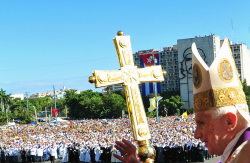


Images of the country’s two revolutionary leaders are also to be found everywhere around Havana, including the famous black portraits silhouetted on the front of the Interior Ministry in Revolution Square where Pope Benedict celebrated Mass on at the end of his visit to Cuba. The square, made famous by Fidel’s political rallies, was filled with hundreds of thousands of faithful who’d come from all over Cuba, as well as from the United States, to join the Pope in praying for a new kind of revolution here – one that will change hearts, promote peace and set people free.

In his homily Pope Benedict spoke of faith and reason as the two keys for those who pursue the truth – anyone who acts irrationally, he said, cannot become a disciple of Christ. Returning to a central theme of this short visit to Cuba, the Pope stressed that in order to carry out her mission in pursuit of that truth, the Church here must be able to enjoy more freedom to proclaim and celebrate the faith in public and to promote reconciliation, through education and other social services.

Recalling in particular the legacy of Fr Felix Varela, a 19th century Cuban writer, teacher and human rights defender, Pope Benedict said Cuba and the world must change for the benefit of all people here. Many of those gathered in Revolution square will remember similar words spoken by Pope John Paul II on his historic visit to the island 14 years ago – a visit that has been immortalized in statues and pictures of the previous Pope in Churches and shrines around the country. On his visit to the basilica of Our Lady of Charity, patron of the Cuban people, Pope Benedict stood outside between twin statues of his predecessor and Fr Varela, who will soon be on the road to sainthood. Three new icons perhaps for a Church and a nation longing for a brighter future of peace, prosperity and freedom.

Below the text of Pope Benedict XVI’s Homily at Mass in Revolution Square, Havana

Dear Brothers and Sisters,

“Blessed are you, Lord God…, and blessed is your holy and glorious name” (Dan 3:52). This hymn of blessing from the Book of Daniel resounds today in our liturgy, inviting us repeatedly to bless and thank God. We are a part of that great chorus which praises the Lord without ceasing. We join in this concert of thanksgiving, and we offer our joyful and confident voice, which seeks to consolidate the journey of faith in love and truth.

“Blessed be God” who gathers us in this historic square so that we may more profoundly enter into his life. I feel great joy in being here with you today to celebrate Holy Mass during this Jubilee Year devoted to Our Lady of Charity of El Cobre.

I greet with cordial affection Cardinal Jaime Ortega y Alamino, Archbishop of Havana, and I thank him for the kind words which he has addressed to me on your behalf. I extend warm greetings to the Cardinals and to my brother Bishops of Cuba and other countries who wished to take part in this solemn celebration. I also greet the priests, seminarians, men and women religious, and all the lay faithful gathered here, as well as the civil authorities who join us.

In today’s first reading, the three young men persecuted by the Babylonian king preferred to face death by fire rather than betray their conscience and their faith. They experienced the strength to “give thanks, glorify and praise God” in the conviction that the Lord of the universe and of history would not abandon them to death and annihilation. Truly, God never abandons his children, he never forgets them. He is above us and is able to save us by his power. At the same time, he is near to his people, and through his Son Jesus Christ he has wished to make his dwelling place among us in.

“If you continue in my word, you are truly my disciples, and you will know the truth, and the truth will make you free” (Jn 8:31). In this text from today’s Gospel, Jesus reveals himself as the Son of God the Father, the Saviour, the one who alone can show us the truth and give genuine freedom. His teaching provokes resistance and disquiet among his hearers, and he accuses them of seeking to kill him, alluding to the supreme sacrifice of the Cross, already imminent. Even so, he exhorts them to believe, to keep his word, so as to know the truth which redeems and dignifies.

The truth is a desire of the human person, the search for which always supposes the exercise of authentic freedom. Many, however, prefer shortcuts, trying to avoid this task. Some, like Pontius Pilate, ironically question the possibility of even knowing what truth is (cf. Jn 18:38), proclaiming that man is incapable of knowing it or denying that there exists a truth valid for all. This attitude, as in the case of scepticism and relativism, changes hearts, making them cold, wavering, distant from others and closed. They, like the Roman governor, wash their hands and let the water of history drain away without taking a stand.

On the other hand, there are those who wrongly interpret this search for the truth, leading them to irrationality and fanaticism; they close themselves up in “their truth”, and try to impose it on others. These are like the blind scribes who, upon seeing Jesus beaten and bloody, cry out furiously, “Crucify him!” (cf. Jn 19:6). Anyone who acts irrationally cannot become a disciple of Jesus. Faith and reason are necessary and complementary in the pursuit of truth. God created man with an innate vocation to the truth and he gave him reason for this purpose. Certainly, it is not irrationality but rather the yearning for truth which the Christian faith promotes. Each human being has to seek the truth and to choose it when he or she finds it, even at the risk of embracing sacrifices.

Furthermore, the truth which stands above humanity is an unavoidable condition for attaining freedom, since in it we discover the foundation of an ethics on which all can converge and which contains clear and precise indications concerning life and death, duties and rights, marriage, family and society, in short, regarding the inviolable dignity of the human person. This ethical patrimony can bring together different cultures, peoples and religions, authorities and citizens, citizens among themselves, and believers in Christ and non-believers.

Christianity, in highlighting those values which sustain ethics, does not impose, but rather proposes Christ’s invitation to know the truth which sets us free. The believer is called to offer that truth to his contemporaries, as did the Lord, even before the dark omen of rejection and the Cross. The personal encounter with the one who is Truth in person compels us to share this treasure with others, especially by our witness.

Dear friends, do not hesitate to follow Jesus Christ. In him we find the truth about God and about mankind. He helps us to overcome our selfishness, to rise above our ambitions and to conquer all that oppresses us. The one who does evil, who sins, becomes a slave of sin and will never attain freedom (cf. Jn 8:34). Only by renouncing hatred and our hard and blind hearts will we be free and a new life will well up in us.

Convinced that it is Christ who is the true measure of man, and knowing that in him we find the strength needed to face every trial, I wish to proclaim openly Jesus Christ as the way, the truth and the life. In him everyone will find complete freedom, the light to understand reality more deeply and to transform it by the renewing power of love.

The Church lives to make others sharers in the one thing she possesses, which is none other than Christ, our hope of glory (cf. Col 1:27). To carry out this duty, she must count on basic religious freedom, which consists in her being able to proclaim and to celebrate her faith also in public, bringing to others the message of love, reconciliation and peace which Jesus brought to the world. It must be said with joy that in Cuba steps have been taken to enable the Church to carry out her essential mission of expressing her faith openly and publicly. Nonetheless, this must continue forwards, and I wish to encourage the country’s Government authorities to strengthen what has already been achieved and advance along this path of genuine service to the true good of Cuban society as a whole.

The right to freedom of religion, both in its private and in its public dimension, manifests the unity of the human person, who is at once a citizen and a believer. It also legitimizes the fact that believers have a contribution to make to the building up of society. Strengthening religious freedom consolidates social bonds, nourishes the hope of a better world, creates favourable conditions for peace and harmonious development, while at the same time establishing solid foundations for securing the rights of future generations.

When the Church upholds this human right, she is not claiming any special privileges for herself. She wishes only to be faithful to the command of her divine founder, conscious that, where Christ is present, mankind becomes more human and founds its consistency. This is why the Church seeks to give witness by her preaching and teaching, both in catechesis and in schools and universities. It is greatly to be hoped that the moment will soon arrive when, here too, the Church can bring to the arenas of knowledge the benefits of the mission which the Lord entrusted to her and which she can never neglect.

A shining example of this commitment was the outstanding priest Félix Varela, educator and teacher, an illustrious son of this city of Havana, who has taken his place in Cuban history as the first one who taught his people how to think. Father Varela offers us a path to a true social transformation: to form virtuous men and women in order to forge a worthy and free nation, for this transformation depends on man’s spiritual life, in as much as “there is no authentic fatherland without virtue” (Letters to Elpidio, Letter 6, Madrid 1836, 220). Cuba and the world need change, but this will occur only if each one is in a position to seek the truth and chooses the way of love, sowing reconciliation and fraternity.

Invoking the maternal protection of Mary Most Holy, let us ask that each time we participate in the Eucharist we will also become witnesses to that charity which responds to evil with good (cf. Rom 12:51), offering ourselves as a living sacrifice to the one who lovingly gave himself up for our sake. Let us walk in the light of Christ who alone can destroy the darkness of error. And let us beg him that, with the courage and strength of the saints, we may be able, without fear or rancour but freely, generously and consistently, to respond to God. Amen.

Pope Benedict XVI's Homily at Santiago de Cuba on Monday, March 26, 2012

Pope Benedict celebrated mass in Maceo Square in Santiago de Cuba on Monday before thousands of the Cuban faithful. In his homily the Pope told them Mary occupies a central placre in the Christian faith and in the life of the Church in Cuba which is celebrating the 400th anniversary of Our Lady of Charity of El Cobre. Below is the full text of the Pope's homily:


Dear Brothers and Sisters,

I give thanks to God who has allowed me to come to you and to make this much anticipated trip. I greet Bishop Dionisio García Ibáñez, Archbishop of Santiago de Cuba, and I thank him for his warm words of welcome offered on behalf of everyone. I greet the Bishops of Cuba and those who have come from elsewhere, and the priests, religious men and women, seminarians and lay faithful present for this celebration. I cannot forget all those who, for reasons of illness, advanced age or for other motives, are not able to join us. I also greet the civil Authorities who have graciously wished to join us.

This first Holy Mass which I have the joy of celebrating during my pastoral visit to this country, takes place in the context of the Marian Jubilee Year called to honour and to venerate Our Lady of Charity of El Cobre, Patroness of Cuba, in this fourth centenary of the discovery and presence of her venerable statue in this blessed land. I cannot forget the sacrifices and the dedication with which this jubilee has been prepared, especially spiritually. I was deeply touched to hear of the fervour with which Mary has been welcomed and invoked by so many Cubans during her journey to every corner of the island.

These important events in the Church in Cuba take on a special lustre because of the feast celebrated today throughout the universal Church: the Annunciation of the Lord to the Virgin Mary. The Incarnation of the Son of God is the central mystery of the Christian faith, and in it Mary occupies a central place. But, we ask, what is the meaning of this mystery? And, what importance does it have for our concrete lives?

First of all, let us see what the Incarnation means. In the Gospel of Saint Luke we heard the words of the angel to Mary: “The Holy Spirit will come upon you, and the power of the Most High will overshadow you; therefore the child to be born will be called holy, the Son of God” (Lk 1:35). In Mary, the Son of God is made man, fulfilling in this way the prophecy of Isaiah: “Behold, a young woman shall conceive and bear a son, and shall call his name Immanuel, which means ‘God-with-us’” (Is 7:14). Jesus, the Word made flesh, is truly God-with-us, who has come to live among us and to share our human condition. The Apostle Saint John expresses it in the following way: “And the Word became flesh and dwelt among us” (Jn 1:14). The expression, “became flesh” points to our human reality in most concrete and tangible way. In Christ, God has truly come into the world, he has entered into our history, he has set his dwelling among us, thus fulfilling the deepest desire of human beings that the world may truly become a home worthy of humanity. On the other hand, when God is put aside, the world becomes an inhospitable place for man, and frustrates creation’s true vocation to be a space for the covenant, for the “Yes” to the love between God and humanity who responds to him. Mary did so as the first fruit of believers with her unreserved “Yes” to the Lord.

For this reason, contemplating the mystery of the Incarnation, we cannot fail to turn our eyes to her so as to be filled with wonder, gratitude and love at seeing how our God, coming into the world, wished to depend upon the free consent of one of his creatures. Only from the moment when the Virgin responded to the angel, “Behold, I am the handmaid of the Lord; let it be to me according to your word” (Lk 1:38), did the eternal Word of the Father began his human existence in time. It is touching to see how God not only respects human freedom: he almost seems to require it. And we see also how the beginning of the earthly life of the Son of God was marked by a double “Yes” to the saving plan of the Father - that of Christ and that of Mary. This obedience to God is what opens the doors of the world to the truth, to salvation. God has created us as the fruit of his infinite love; hence, to live in accordance with his will is the way to encounter our genuine identity, the truth of our being, while apart from God we are alienated from ourselves and are hurled into the void. The obedience of faith is true liberty, authentic redemption, which allows us to unite ourselves to the love of Jesus in his determination to conform himself to the will of the Father. Redemption is always this process of the lifting up of the human will to full communion with the divine will (cf. Lectio Divina with the parish priests of Rome, 18 February 2010).

Dear brothers and sisters, today we praise the Most Holy Virgin for her faith, and with Saint Elizabeth we too say, “Blessed is she who believed” (Lk 1:45). As Saint Augustine said, Mary conceived Christ by faith in her heart before she conceived him physically in her womb; Mary believed and what she believed was came to be in her (cf. Sermo 215, 4: PL 38, 1074). Let us ask the Lord to strengthen our faith, to make it active and fruitful in love. Let us implore him that, like her, we may welcome the word of God into our hearts, and carry it out with docility and constancy.

The Virgin Mary, by her unique role in the mystery of Christ, represents the exemplar and model of the Church. The Church, like the Mother of Christ, is also called to embrace in herself the mystery of God who comes to live in her. Dear brothers and sisters, I know with what effort, boldness and self-sacrifice you work every day so that, in the concrete circumstances of your country, and at this moment in history, the Church will better present her true face as a place in which God draws near and encounters humanity. The Church, the living body of Christ, has the mission of prolonging on earth the salvific presence of God, of opening the world to something greater than itself, to the love and the light of God. It is worth the effort, dear brothers and sisters, to devote your entire life to Christ, to grow in his friendship each day and to feel called to proclaim the beauty and the goodness of his life to every person, to all our brothers and sisters. I encourage you in this task of sowing the word of God in the world and offering to everyone the true nourishment of the body of Christ. Easter is already approaching; let us determine to follow Jesus without fear or doubts on his journey to the Cross. May we accept with patience and faith whatever opposition or affliction may come, with the conviction that, in his Resurrection, he has crushed the power of evil which darkens everything, and has brought the dawn of a new world, the world of God, of light, of truth and happiness. The Lord will not fail to bless with abundant fruits the generosity of your commitment.

The mystery of the Incarnation, in which God draws near to us, also shows us the incomparable dignity of every human life. In his loving plan, from the beginning of creation, God has entrusted to the family founded on matrimony the most lofty mission of being the fundamental cell of society and an authentic domestic church. With this certainty, you, dear husbands and wives, are called to be, especially for your children, a real and visible sign of the love of Christ for the Church. Cuba needs the witness of your fidelity, your unity, your capacity to welcome human life, especially that of the weakest and most needy.

Dear brothers and sisters, before the gaze of Our Lady of Charity of El Cobre, I appeal to you to reinvigorate your faith, that you may live in Christ and for Christ, and armed with peace, forgiveness and understanding, that you may strive to build a renewed and open society, a better society, one more worthy of humanity, and which better reflects the goodness of God. Amen.


Pope Benedict XVI's Sunday Homily in Leon, Mexico on March 25, 2012


Some 500 thousand faithful turned out on a splendid sunny day in Leon, Mexico for a big outdoor mass in the city's Bicentenary Park celebrated by Pope Benedict XVI. In his homily on this, the fifth Sunday of Lent, the Holy Father prayed that Christ "reign in our hearts, making them pure, docile, filled with hope and courageous in humility" and urged Catholics to "resist the temptation of a faith that is superficial and routine, at times fragmentary and incoherent. Here, we need to overcome fatigue related to faith and rediscover the joy of being Christians."

Below is the full translation of the Pope's homily:

Dear Brothers and Sisters,

I am very pleased to be among you today and I express my sincere gratitude to the Most Reverend José Guadalupe Martín Rábago, Archbishop of León, for his kind words of welcome. I greet the Mexican Bishops, and the Cardinals and other Bishops present here, and in a special way those who have come from Latin America and the Caribbean. I also extend a warm greeting to the authorities that are with us, as well as all who have gathered for this Holy Mass presided by the Successor of Peter.

We said, “A pure heart, create for me, O God” (Ps 50:12) during the responsorial psalm. This exclamation shows us how profoundly we must prepare to celebrate next week the great mystery of the passion, death and resurrection of the Lord. It also helps us to look deeply into the human heart, especially in times of sorrow as well as hope, as are the present times for the people of Mexico and of Latin America.

The desire for a heart that would be pure, sincere, humble, acceptable to God was very much felt by Israel as it became aware of the persistence in its midst of evil and sin as a power, practically implacable and impossible to overcome. There was nothing left but to trust in God’s mercy and in the hope that he would change from within, from the heart, an unbearable, dark and hopeless situation. In this way recourse gained ground to the infinite mercy of the Lord who does not wish the sinner to die but to convert and live (cf. Ez 33:11). A pure heart, a new heart, is one which recognizes that, of itself, it is impotent and places itself in God’s hands so as to continue hoping in his promises. Then the psalmist can say to the Lord with conviction: “Sinners will return to you” (Ps 50:15). And towards the end of the psalm he will give an explanation which is at the same time a firm conviction of faith: “A humble, contrite heart you will not spurn” (v. 19).

The history of Israel relates some great events and battles, but when faced with its more authentic existence, its decisive destiny, its salvation, it places its hope not in its own efforts, but in God who can create a new heart, not insensitive or proud. This should remind each one of us and our peoples that, when addressing the deeper dimension of personal and community life, human strategies will not suffice to save us. We must have recourse to the One who alone can give life in its fullness, because he is the essence of life and its author; he has made us sharers in the same through his Son Jesus Christ.

Today’s Gospel takes up the topic and shows us how this ancient desire for the fullness of life has actually been achieved in Christ. Saint John explains it in a passage in which the wish of some Greeks to see Jesus coincides with the moment in which the Lord is about to be glorified. Jesus responds to the question of the Greeks, who represent the pagan world, saying: “Now the hour has come for the Son of Man to be glorified” (Jn 12:23). This is a strange response which seems inconsistent with the question asked by the Greeks. What has the glorification of Jesus to do with the request to meet him? But there is a relation. Someone might think – says Saint Augustine – that Jesus felt glorified because the Gentiles were coming to him. This would be similar to the applause of the multitudes who give “glory” to those who are grand in the world, as we would say today. But this is not so. “It was convenient that, before the wonder of his glorification, should come the humility of his passion” (In Joannis Ev. 51:9: PL 35, 1766).

Jesus’ answer, announcing his imminent passion, means that a casual encounter in those moments would have been superficial and perhaps deceptive. The Greeks will see the one they wished to meet raised up on the cross from which he will attract all to himself (cf. Jn 12:32). There his “glory” will begin, because of his sacrifice of expiation for all, as the grain of wheat fallen to the ground that by dying germinates and produces abundant fruit. They will find the one whom, unknown to them, they were seeking in their hearts, the true God who is made visible to all peoples. This was how Our Lady of Guadalupe showed her divine Son to Saint Juan Diego, not as a powerful legendary hero but as the very God of the living, by whom all live, the Creator of persons, of closeness and immediacy, of heaven and earth (cf. Nican Mopohua, v.33). At that moment she did what she had done previously at the wedding feast of Cana. Faced with the embarrassment caused by the lack of wine, she told the servants clearly that the path to follow was her Son: “Do whatever he tells you” (Jn 2:5).

Dear brothers and sisters, by coming here I have been able to visit the monument to Christ the King situated on top of the Cubilete. My venerable predecessor, Blessed Pope John Paul II, although he ardently desired to do so, was unable on his several journeys to this beloved land to visit this site of such significance for the faith of the Mexican people. I am sure that in heaven he is happy that the Lord has granted me the grace to be here with you and that he has blessed the millions of Mexicans who have venerated his relics in every corner of the country. This monument represents Christ the King. But his crowns, one of a sovereign, the other of thorns, indicate that his royal status does not correspond to how it has been or is understood by many. His kingdom does not stand on the power of his armies subduing others through force or violence. It rests on a higher power than wins over hearts: the love of God that he brought into the world with his sacrifice and the truth to which he bore witness. This is his sovereignty which no one can take from him and which no one should forget. Hence it is right that this shrine should be above all a place of pilgrimage, of fervent prayer, of conversion, of reconciliation, of the search for truth and the acceptance of grace. We ask Christ, to reign in our hearts, making them pure, docile, filled with hope and courageous in humility.

From this park, foreseen as a memorial of the bicentenary of the birth of the Mexican nation, bringing together many differences towards one destiny and one common quest, we ask Christ for a pure heart, where he as Prince of Peace may dwell “thanks to the power of God who is the power of goodness, the power of love”. But for God to dwell in us, we need to listen to him; we must allow his Word to challenge us every day, meditating upon it in our hearts after the example of Mary (cf. Lk 2:51). In this way we grow in friendship with him, we learn to understand what he expects from us and we are encouraged to make him known to others.

At Aparecida, the Bishops of Latin America and the Caribbean saw with clarity the need to confirm, renew and revitalize the newness of the Gospel rooted deeply in the history of these lands “on the basis of a personal and community encounter with Jesus Christ which raises up disciples and missionaries” (Final Document, 11). The Continental Mission now taking place in the various dioceses of this continent has the specific task of transmitting this conviction to all Christians and ecclesial communities so that they may resist the temptation of a faith that is superficial and routine, at times fragmentary and incoherent. Here we need to overcome fatigue related to faith and rediscover “the joy of being Christians, of being sustained by the inner happiness of knowing Christ and belonging to his Church. From this joy spring the energies that are needed to serve Christ in distressing situations of human suffering, placing oneself at his disposition and not falling back on one’s own comfort” (Address to the Roman Curia, 22 December 2011). This can be seen clearly in the saints who dedicated themselves fully to the cause of the Gospel with enthusiasm and joy without counting the cost, even of life itself. Their heart was centred entirely on Christ from whom they had learned what it means to love until the end.

In this sense the Year of Faith, to which I have convoked the whole Church, “is an invitation to an authentic and renewed conversion to the Lord, the only Saviour of the world […]. Faith grows when it is lived as an experience of love received and when it is communicated as an experience of grace and joy” (Porta Fidei 6, 7).

Let us ask the Blessed Virgin Mary to assist us in purifying our hearts, especially in view of the coming Easter celebrations, that we may enter more deeply the salvific mystery of her Son, as she made it known in this land. And let us also ask her to continue accompanying and protecting her Mexican and Latin American children, that Christ may reign in their lives and help them boldly to promote peace, harmony, justice and solidarity. Amen.